







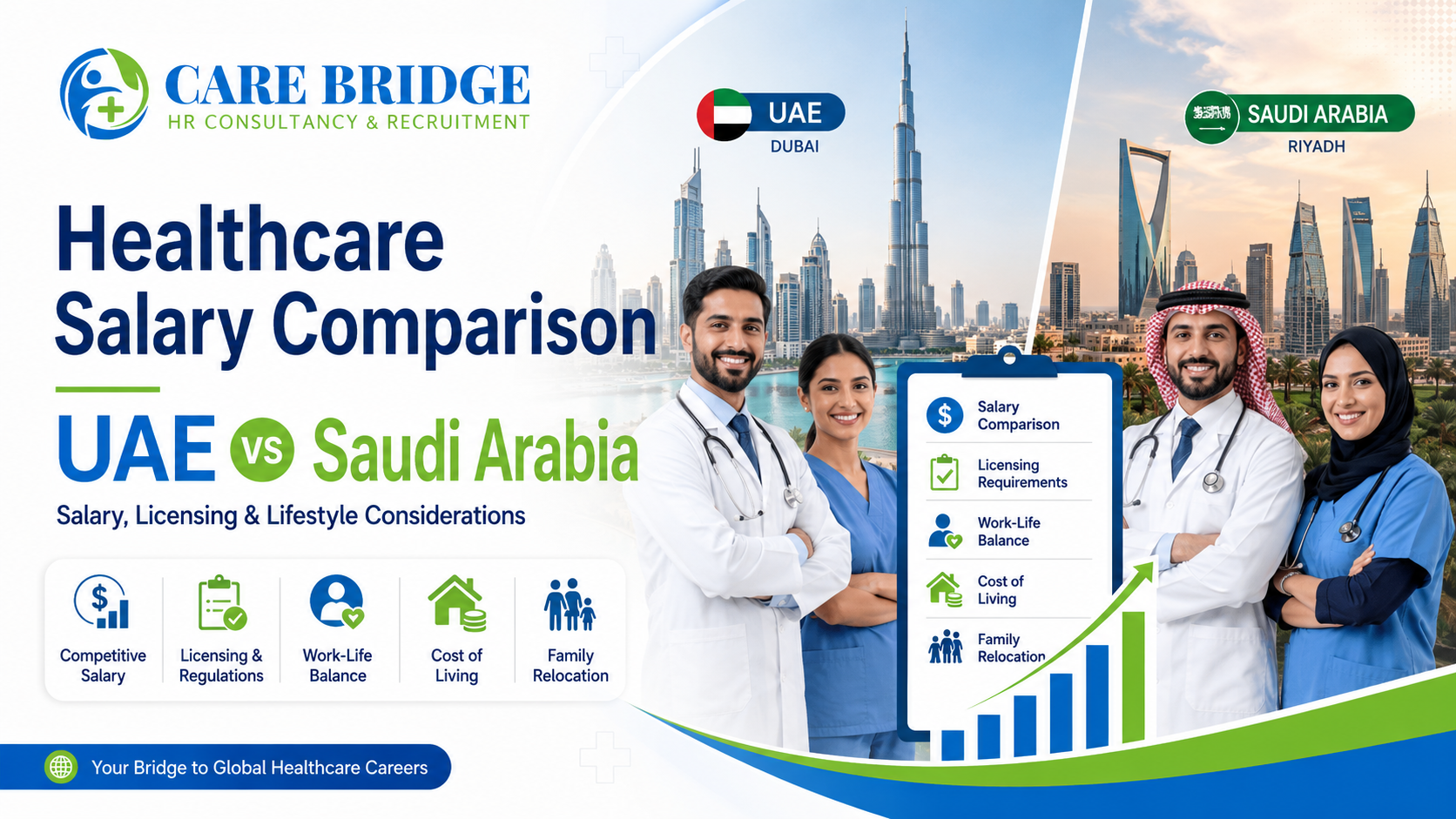
Healthcare Salary Comparison: UAE vs Saudi Arabia
The UAE and Saudi Arabia remain two of the strongest destinations for international healthcare professionals in the GCC. Both countries attract doctors, nurses, dentists, pharmacists, allied health professionals, and senior consultants from around the world. They offer modern hospitals, international patient care standards, tax-free or low-tax income structures, and strong career growth opportunities.
However, salary should never be the only factor when choosing between the UAE and Saudi Arabia. A higher monthly package may not always create a better overall career move. Healthcare professionals also need to consider licensing, family relocation, cost of living, employer type, workload, career progression, and long-term lifestyle goals.
For candidates planning a move to the Gulf, the right decision depends on the full picture. Care Bridge Human Resource Consultancies supports healthcare professionals with recruitment, licensing guidance, relocation preparation, and employer coordination across the GCC. This guide compares healthcare salary expectations in the UAE and Saudi Arabia and explains the wider factors professionals should review before accepting an offer.
Why the UAE and Saudi Arabia Attract Healthcare Professionals
The UAE and Saudi Arabia continue to invest heavily in healthcare infrastructure. Both markets need qualified international professionals to support hospital growth, specialty services, digital health, private healthcare expansion, and population health needs.
The UAE attracts professionals who want a fast-moving, international healthcare environment. Dubai, Abu Dhabi, Sharjah, and the Northern Emirates offer strong private-sector opportunities, multicultural communities, and a well-developed urban lifestyle. Many candidates also value the UAE’s connectivity, schooling options, and global business environment.
Saudi Arabia offers a different opportunity. The Kingdom has a large healthcare system with major government, semi-government, and private hospital networks. It continues to expand healthcare capacity under national transformation programmes, including the official Saudi Health Sector Transformation Program. This creates demand for senior consultants, specialist doctors, nurses, and allied health professionals across multiple regions.
CareBridge supports both pathways by helping professionals understand where their profile fits best. Candidates can explore wider GCC opportunities through CareBridge’s healthcare recruitment support before choosing a target country.
Salary Differences: UAE vs Saudi Arabia
Healthcare salaries in the UAE and Saudi Arabia vary by profession, specialty, experience, employer type, location, and licensing status. A consultant surgeon in a government hospital will not receive the same package as a junior nurse in a private clinic. A specialist doctor in Abu Dhabi may receive a different offer from a specialist doctor in Riyadh, Jeddah, or the Eastern Province.
In general, the UAE often offers wider salary variation because its healthcare market has a strong private-sector structure. Dubai and Abu Dhabi include premium private hospitals, outpatient clinics, medical centres, aesthetic clinics, rehabilitation providers, homecare companies, and specialist facilities. This creates flexibility, but it also means offers can differ widely.
Saudi Arabia often provides competitive packages for senior consultants and specialists, especially in large hospital groups, government-linked institutions, and high-demand specialties. Some consultant-level roles in Saudi Arabia may offer stronger total compensation than similar roles in the UAE, particularly when housing, transport, schooling, or family benefits form part of the package.
For nurses and allied health professionals, the comparison depends heavily on the employer. Some UAE employers offer attractive urban work environments and faster private-sector hiring. Some Saudi employers may provide more structured accommodation or benefit packages. The best choice depends on the total offer, not only the basic salary.
Healthcare professionals can review active regional opportunities through CareBridge healthcare job openings to compare role types, locations, and employer requirements.
UAE Salary Factors for Healthcare Professionals
The UAE healthcare market rewards professionals who match employer demand, licensing requirements, and specialty needs. Salary packages may change based on emirate, facility type, workload, patient volume, and whether the role sits in a hospital, clinic, homecare service, or specialty centre.
Dubai and Abu Dhabi often attract candidates because they offer strong lifestyle benefits, international schooling, modern housing, and global connectivity. However, these benefits may come with a higher cost of living. Rent, transport, schooling, and family expenses can reduce the value of a salary package if candidates do not plan carefully.
The UAE also has a strong private healthcare market. This can create excellent opportunities for professionals in specialties such as dermatology, aesthetics, orthopaedics, dentistry, rehabilitation, fertility, cardiology, radiology, emergency medicine, and nursing. However, private-sector packages can vary. Some employers may offer higher basic pay but fewer family benefits. Others may offer lower basic pay with better stability, insurance, or working conditions.
Professionals who plan to work in the UAE must also complete the right licensing pathway. Depending on location, this may involve DHA, DOH, MOHAP, or DHCC requirements. CareBridge explains these options in detail through its guide on comparing DHA, DHCC, and MOHAP licensing.
Saudi Arabia Salary Factors for Healthcare Professionals
Saudi Arabia offers strong opportunities for consultants, specialists, nurses, and allied healthcare professionals. The market includes major government hospitals, military and university hospitals, private hospital groups, specialist centres, and new healthcare projects.
Senior doctors may find Saudi Arabia especially attractive because consultant-level packages can include housing, annual flights, medical insurance, paid leave, and education support. These benefits can improve the real value of the offer. In some cases, a Saudi package with strong allowances may provide better savings potential than a higher-looking UAE salary with fewer benefits.
Saudi Arabia also has a larger geographic market. Riyadh, Jeddah, Dammam, Khobar, Madinah, and other regions may offer different salary levels and lifestyle experiences. Major cities usually provide more international amenities, while other regions may offer strong packages to attract qualified professionals.
Healthcare professionals must hold the correct Saudi licensing status before practising. The Saudi Commission for Health Specialties manages professional registration through Mumaris Plus, and applicants must complete the required steps through the official SCFHS professional registration process. Candidates should prepare early because classification, verification, exams, and registration steps can affect joining timelines.
Licensing Differences Between the UAE and Saudi Arabia
Licensing plays a major role in salary negotiation and job readiness. Employers value candidates who understand the process and can move quickly through regulatory steps.
In the UAE, licensing depends on the emirate and authority. Dubai healthcare professionals usually follow DHA requirements. Abu Dhabi professionals follow DOH requirements. Northern Emirates roles may fall under MOHAP. Some Dubai Healthcare City roles may require DHCC licensing. The DHA explains that professional registration confirms that an applicant meets the requirements for the applied category, title, and specialty, and the facility must activate the registration into a license before practice through the official DHA healthcare professional registration service.
In Saudi Arabia, professionals usually follow the SCFHS pathway. This may include professional classification, document verification, exams where required, and registration through Mumaris Plus.
These differences matter because a strong salary offer has limited value if the licensing pathway is unclear. A candidate may receive an attractive package but face delays due to missing documents, experience gaps, expired certificates, or authority-specific requirements. CareBridge helps candidates prepare stronger applications through its healthcare licensing services.
Cost of Living and Lifestyle Considerations
A salary comparison must include lifestyle. The UAE and Saudi Arabia offer different living environments, and each can suit different career stages.
The UAE may suit professionals who prefer a highly international lifestyle, strong private schooling options, global travel access, and a fast-paced urban environment. Dubai and Abu Dhabi offer many residential communities, shopping areas, entertainment options, and international networks. However, rent and schooling can be expensive, especially for families.
Saudi Arabia may suit professionals who want larger employer packages, strong savings potential, and long-term career opportunities in a growing healthcare system. Some employers provide housing or accommodation allowances that reduce monthly expenses. Family policies vary, so candidates should check schooling, dependent visas, medical insurance, and leave benefits before accepting an offer.
Work-life balance also differs by employer. A private clinic in Dubai may have different working hours from a tertiary hospital in Riyadh. A government-linked hospital may offer a different structure from a private medical centre. Candidates should ask about shifts, call duties, patient volume, annual leave, and overtime policies.
Family Relocation and Benefits
Family relocation can change the value of a healthcare package. A single professional may focus on salary, accommodation, and career growth. A professional relocating with a spouse and children must review schooling, housing, family medical insurance, visa support, and annual tickets.
Some Saudi packages may include stronger family-related allowances for senior roles. Some UAE employers may offer flexibility, better schooling access, or more lifestyle convenience depending on the city and role. There is no single best option for every professional.
Before accepting an offer, candidates should request a full breakdown of salary and benefits. This should include basic salary, housing, transport, health insurance, annual leave, flights, education support, bonus potential, probation terms, notice period, and licensing support. CareBridge can help candidates assess offer quality and prepare for relocation through its get recruited eligibility pathway.
How to Compare Offers Correctly
Healthcare professionals should compare total value, not only monthly salary. A strong offer should support career growth, licensing success, financial stability, and personal wellbeing.
Before choosing between the UAE and Saudi Arabia, ask these questions:
- Is the salary basic-only or full package?
- Does the offer include housing or accommodation allowance?
- Does the employer cover licensing costs?
- Will the employer support visa processing and family relocation?
- What are the working hours and on-call duties?
- Is the role in a hospital, clinic, homecare service, or specialist centre?
- Does the license pathway match my qualifications and experience?
- Can this role improve my long-term career profile?
Document readiness also affects the process. Missing or inconsistent documents can delay both licensing and onboarding. Candidates preparing for UAE licensing can review CareBridge’s UAE licensing document checklist before starting applications.
FAQ: Healthcare Salary Comparison Between UAE and Saudi Arabia
1. Which country pays healthcare professionals more, the UAE or Saudi Arabia?
It depends on the role, specialty, employer, and benefits. Saudi Arabia may offer stronger packages for some senior consultants, especially in government-linked hospitals. The UAE may offer strong private-sector opportunities with wider salary variation.
2. Is income tax-free in the UAE and Saudi Arabia?
Both markets are widely known for attractive income structures compared with many Western countries. However, professionals should seek updated tax advice based on nationality, residence status, home-country obligations, and contract structure.
3. Which country is better for doctors?
Saudi Arabia may suit consultants who want large hospital systems and strong packages. The UAE may suit doctors who want private-sector exposure, international lifestyle, and urban healthcare opportunities. The better option depends on specialty, license eligibility, and career goals.
4. Which country is better for nurses?
Both countries offer strong nursing opportunities. The UAE may appeal to nurses who prefer urban lifestyle and private healthcare settings. Saudi Arabia may offer structured hospital roles and benefit packages. Nurses should compare accommodation, shifts, leave, and licensing support.
5. Do I need a separate license for each country?
Yes. The UAE and Saudi Arabia have different licensing authorities. UAE professionals may need DHA, DOH, MOHAP, or DHCC approval. Saudi Arabia requires SCFHS classification and registration.
6. Should I choose the highest salary offer?
Not always. Salary matters, but licensing pathway, employer reputation, workload, benefits, cost of living, and family needs matter equally. A slightly lower salary with stronger benefits may create better savings and stability.
Conclusion
The UAE and Saudi Arabia both offer excellent healthcare career opportunities, but they suit different professionals in different ways. The UAE provides a dynamic private healthcare market, international lifestyle, and strong opportunities across Dubai, Abu Dhabi, and the Northern Emirates. Saudi Arabia offers large-scale healthcare growth, competitive consultant packages, and major opportunities linked to national transformation.
Healthcare professionals should not choose based only on salary. They should compare licensing requirements, employer benefits, family relocation, cost of living, work-life balance, and long-term career value. The best offer is the one that matches professional goals and personal circumstances.
Care Bridge Human Resource Consultancies helps healthcare professionals make informed GCC career decisions. Through recruitment support, licensing guidance, document preparation, and relocation coordination, CareBridge helps candidates move from opportunity to onboarding with confidence.