






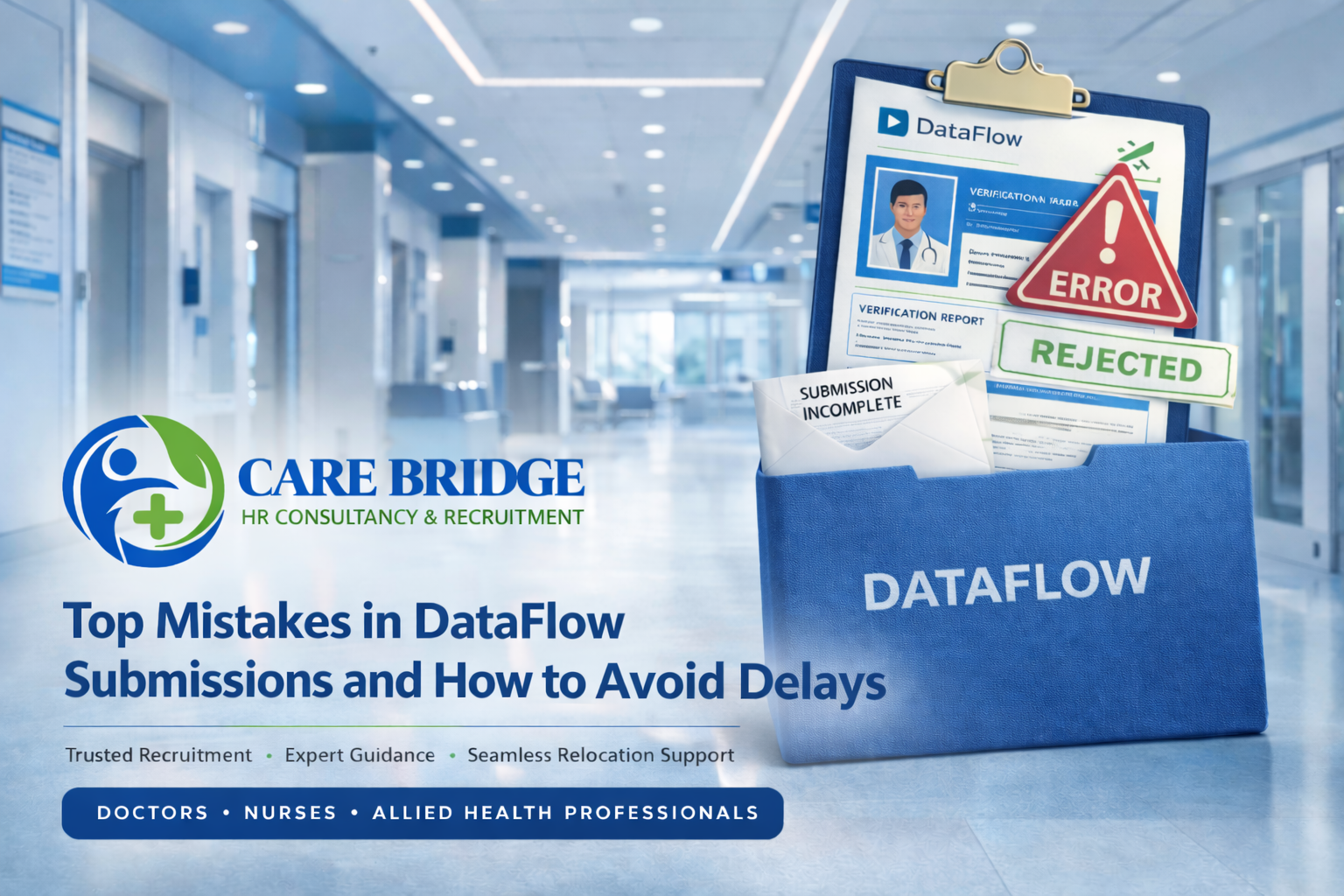
Top Mistakes in DataFlow Submissions and How to Avoid Delays
For healthcare professionals applying for licensure in the UAE, DataFlow is one of the most important steps in the process. It is also one of the easiest stages to get wrong. Many applicants focus on exams, job offers, and licensing authority approvals, but document verification often creates the first serious delay. In most cases, the problem does not start with the authority. It starts with preventable mistakes in the application itself.
Care Bridge highlights DataFlow as one of the most critical and commonly misunderstood stages in the licensing journey. Its guidance warns that delays or failures at this point can set the whole application back by months. DataFlow Group also confirms that it provides Primary Source Verification, or PSV, for professional credentials such as qualifications, licences, and employment records.
That is why accuracy matters from the beginning. A clear and complete application helps your licensing journey move faster. A weak application can delay verification, postpone employer onboarding, and affect your expected joining date. This is exactly why Care Bridge encourages applicants to prepare documents carefully before submission, not after a problem appears. Care Bridge’s healthcare licensing support page explains that DataFlow, document readiness, and regulatory accuracy all play a direct role in GCC healthcare licensing timelines.
Why DataFlow delays happen so often
Many DataFlow delays come from simple errors. Applicants often submit documents with missing details, inconsistent dates, or unclear scans. These issues seem minor at first. But verification depends on precision. If a university, licensing body, or former employer cannot identify the document or confirm the record quickly, the case slows down.
DataFlow’s own FAQs and support materials make this clear. Applicants may need extra supporting evidence when names differ across documents, and uploaded files should be clear scanned copies. This shows that DataFlow is not just a file-upload exercise. It is a consistency check across your professional history. Every document should support the same record of who you are, where you trained, where you worked, and when each stage happened.
The most frequent mistakes in DataFlow submissions
Incorrect contact details
Applicants often enter the wrong university department, outdated employer contact details, or incomplete institutional information. This mistake creates avoidable delays. If the verifier cannot reach the right source, the case may pause while more information is requested.
Many professionals assume the document alone is enough. It is not. Verification depends on traceable information. That is one reason Care Bridge advises applicants to review every supporting detail before they submit. Its complete DataFlow verification guide focuses heavily on document preparation, common failures, and how to avoid delays from the start.
Incomplete experience letters
Experience letters are another major problem area. Many applicants upload letters that miss key details such as official letterhead, exact employment dates, job title, authorised signature, or enough information to confirm the role properly. When that happens, verification becomes harder and slower.
Care Bridge’s UAE licensing document checklist states that incomplete or incorrect documentation is the most common reason for delays and rejections in healthcare licensing across the UAE. That makes experience letters more important than many candidates realise.
Mismatched employment dates
Date mismatches create another common delay. Your CV may show one set of employment dates, while your experience letter or licence history shows another. Even a small inconsistency can trigger a clarification request.
Applicants often see this as a harmless typo. Verifiers do not. They need a clear and consistent timeline. If one document says March 2021 to July 2023 and another says April 2021 to June 2023, the mismatch can slow the review. The goal is not just to provide documents. The goal is to present one consistent professional history across every file.
Poor-quality document scans
Poor scans also cause unnecessary delays. Blurred pages, cropped seals, cut-off signatures, sideways files, and low-resolution images all make verification harder. The applicant may know what the document says, but the verifier must still read it clearly and confirm that it is complete.
DataFlow support specifically says applicants should upload clear scanned copies. That sounds basic, but it matters a great deal in practice. A poor scan can delay the case just as much as a missing document.
How to avoid delays in your DataFlow application
Double-check institution and employer details
Start by reviewing the official details of every university, licensing body, and employer in your application. Confirm names, departments, and contact channels. If an institution has changed its name, merged with another entity, or updated its department structure, make that clear in your supporting documents.
This step sounds small, but it improves traceability. The easier you make the source verification process, the faster your case can move.
Use formal experience letters with complete details
Your experience letter should look official and read clearly. Use formal letterhead where required. Include exact employment dates, correct role titles, and an appropriate signature. Make sure the content matches your licensing pathway and the role you want to register under.
Care Bridge repeatedly stresses that strong document preparation reduces friction throughout the licensing process. Applicants who build cleaner files from the beginning often avoid the back-and-forth that slows down weaker cases.
Align your CV with every supporting document
Your CV should match your experience letters, licences, and application form. Dates should line up. Job titles should remain consistent. Employers and institutions should appear in the same format wherever possible.
This is where many applicants make avoidable mistakes. They update the CV but forget to review their older supporting documents. Or they simplify titles in one place and use formal titles in another. That creates confusion. A clean submission tells one consistent story from beginning to end.
Upload only clear, complete files
Before uploading, inspect every file carefully. Make sure each page is visible. Check that stamps, signatures, and seals are readable. Confirm that multi-page documents are complete and in the correct order. If translation is required, include the correct translated version.
DataFlow support says clear scanned copies help prevent delays. In real terms, this means your files should be easy to read without guessing or zooming.
Review everything before you submit
The best time to catch a mistake is before you click submit. Once a delay begins, fixing it usually costs more time than preventing it. That is why early review matters so much.
Care Bridge’s DHA licensing guide also shows how verification fits into the wider licensing pathway, from eligibility and DataFlow through exams and final activation. A delay in one stage can affect everything that follows.
Why accuracy matters more than applicants think
DataFlow does not sit in isolation. It affects the whole licensing timeline. DHA states that professional registration confirms the applicant meets the requirements for the position and that the registration must then be activated by a healthcare facility into a licence before practice begins. In other words, if verification slows down, the delay can affect registration, activation, onboarding, and your job start date.
That is why document accuracy is not just an administrative issue. It is a career timing issue. Care Bridge positions licensing, verification, recruitment, and onboarding as parts of one connected journey. If one part moves slowly, the rest often slows with it.
FAQ: Top mistakes in DataFlow submissions
What is the most common reason DataFlow applications get delayed?
The most common reasons include incomplete documents, inconsistent employment dates, incorrect contact details, and poor-quality uploads. Care Bridge specifically says incomplete or incorrect documentation is the leading cause of delays and rejections in UAE healthcare licensing.
Do small date mismatches really matter?
Yes. Even small inconsistencies can trigger clarification requests. Verifiers need a clear and reliable timeline across your CV, experience letters, and application form.
Can poor scan quality delay verification?
Yes. DataFlow support says applicants should upload clear scanned copies. Blurred or incomplete files can slow down the review process.
Is DataFlow part of DHA licensing?
Yes. DHA registration guidance states that applicants must complete the required prerequisites and submit the needed documents as part of the professional registration process, while Care Bridge also presents DataFlow and PSV as part of the DHA licensing pathway.
How can I reduce the chance of delays?
Review all documents before submission, align your CV with your supporting records, use complete experience letters, verify contact details, and upload clear files.
Conclusion
DataFlow delays are common, but many of them are avoidable. In most cases, the delay starts with the submission itself. Incorrect contact details, incomplete experience letters, mismatched dates, and poor scans can all slow down a process that should move much faster.
A clean and accurate DataFlow application gives you a better chance of moving through licensing without unnecessary setbacks. For healthcare professionals planning to work in the UAE, careful preparation at the verification stage can save weeks of frustration later. Care Bridge continues to emphasise document readiness, regulatory accuracy, and structured support because these details directly affect licensing timelines and job activation.