





Healthcare Work-Life Balance in the UAE: Reality vs Expectations
Healthcare professionals often move to the UAE with strong expectations. They look forward to international career exposure, modern hospitals, tax-free income, multicultural teams, and a better lifestyle. These expectations are valid. The UAE offers excellent career opportunities for doctors, nurses, dentists, pharmacists, and allied health professionals.
However, work-life balance in healthcare depends on more than location. It varies by employer, specialty, department, shift pattern, patient volume, licensing status, and career level. A government hospital may offer a more structured schedule. A private facility may offer higher earning potential but longer or more flexible working hours. A clinic role may feel different from an emergency department, ICU, operating theatre, or homecare position.
For healthcare professionals planning a move, the key is not to assume that every UAE role offers the same lifestyle. The right decision requires a clear review of working hours, on-call duties, salary expectations, licensing requirements, family needs, and long-term career goals.
Care Bridge Human Resource Consultancies supports healthcare professionals through recruitment, licensing guidance, relocation planning, and employer coordination. This guide explains the reality of healthcare work-life balance in the UAE and helps professionals make informed career decisions.
Why Work-Life Balance Matters in UAE Healthcare
Work-life balance affects clinical performance, patient safety, family life, and long-term career satisfaction. Healthcare professionals often work in demanding environments where attention, emotional control, and sound judgement matter every day. A role that looks attractive on salary alone may become stressful if the schedule does not suit your lifestyle.
In the UAE, healthcare facilities serve a diverse population. Hospitals, clinics, and medical centres may operate across extended hours, weekends, public holidays, and emergency shifts. Some specialties require frequent on-call duties. Others follow more predictable outpatient schedules.
This is why candidates should ask practical questions before accepting an offer. What are the working hours? How many weekly shifts apply? Is there night duty? How often is on-call required? Does the employer provide overtime or compensatory leave? What does the contract say?
Professionals who are still comparing their UAE options can review CareBridge’s guide on healthcare salary comparison between the UAE and Saudi Arabia to understand why salary and lifestyle should be assessed together.
Reality vs Expectations: What Professionals Should Know
Many healthcare professionals expect that moving to the UAE will automatically improve their lifestyle. In some cases, it does. The UAE offers modern housing, safe communities, strong infrastructure, international schools, and excellent travel connectivity. Dubai, Abu Dhabi, Sharjah, and the Northern Emirates all provide different lifestyle advantages.
The reality is more specific. A professional’s daily routine depends heavily on the role. A dermatologist in a private outpatient clinic may have a different schedule from an emergency physician in a hospital. A dental specialist may follow appointment-based hours, while an ICU nurse may work rotating shifts. A physiotherapist in a rehabilitation centre may have a structured timetable, while a homecare nurse may travel between patient locations.
Expectations must therefore match the actual employment setting. Before accepting a UAE healthcare role, professionals should understand the contract, facility type, licensing authority, and shift structure. CareBridge helps candidates match career opportunities with realistic lifestyle expectations through its healthcare recruitment support for candidates.
Government Sector: More Structure, Strong Systems
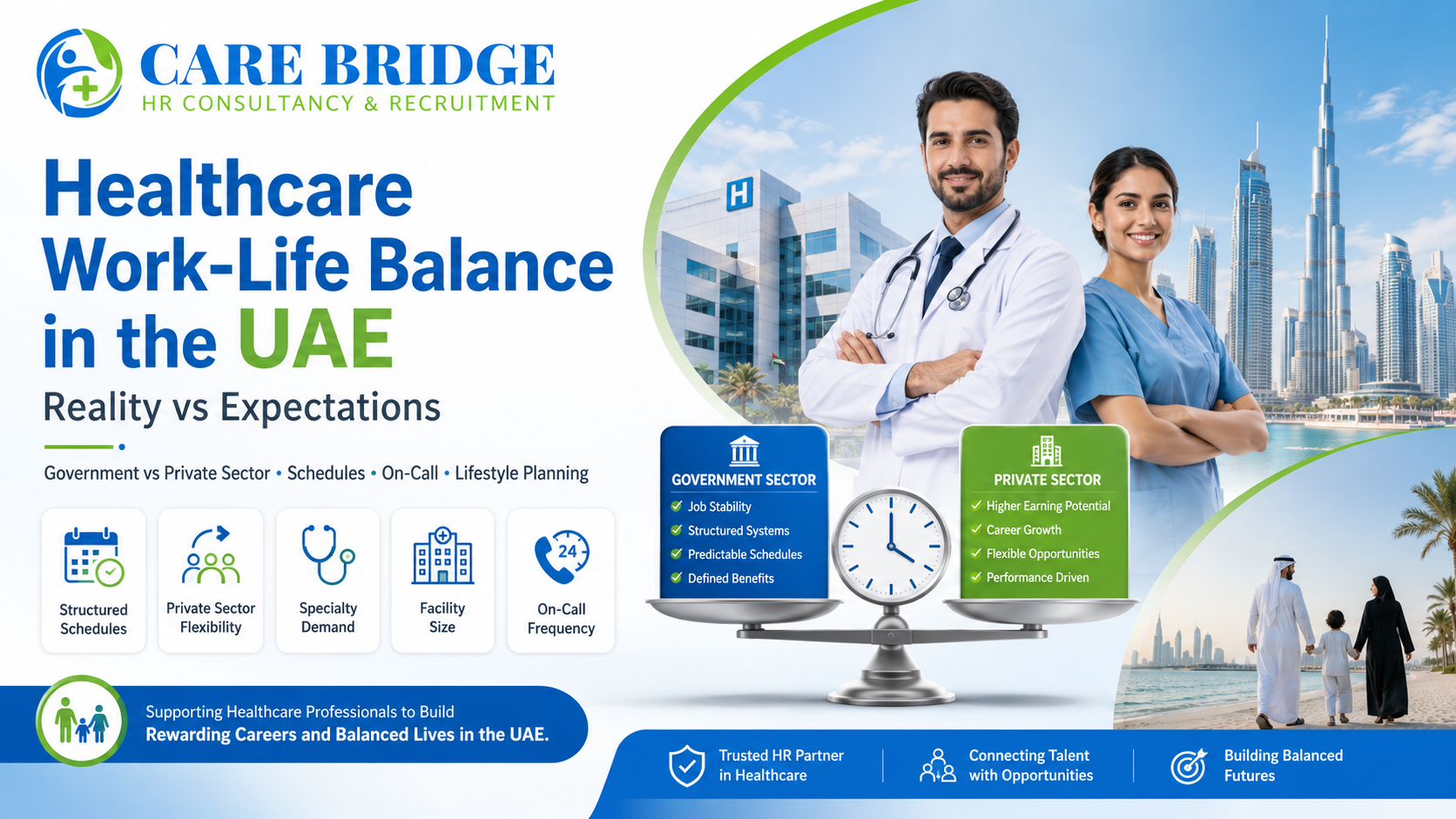
Government and semi-government healthcare facilities in the UAE often provide more structured systems. These organisations usually have established HR policies, defined departments, clear reporting lines, and formal leave processes. They may also offer strong training exposure, multidisciplinary teamwork, and access to advanced clinical systems.
For many professionals, this structure supports better planning. Rotas may follow a clear pattern, and benefits may come with stronger policy backing. Government-linked facilities may also offer stable career pathways, especially for professionals who want long-term clinical development.
However, government roles can still be demanding. Large hospitals may have high patient volume, emergency services, and busy specialty departments. Doctors and nurses in acute settings may still work nights, weekends, and public holidays. Senior professionals may carry on-call responsibilities. Work-life balance may be better organised, but the clinical workload can remain intense.
Professionals should also remember that licensing requirements still apply. Depending on the emirate, a government or semi-government role may require DHA, DOH, MOHAP, or another relevant approval. CareBridge explains these pathways in its guide on comparing DHA, DHCC, and MOHAP licensing.
Private Sector: Flexibility, Opportunity, and Pressure
The private healthcare sector in the UAE offers strong opportunities. Private hospitals, clinics, medical centres, aesthetic clinics, dental practices, rehabilitation centres, and homecare companies continue to recruit international professionals. For some roles, the private sector may offer higher earning potential, faster hiring, and more commercial exposure.
However, private-sector work-life balance can vary widely. Some employers offer well-planned schedules and supportive teams. Others may require longer shifts, evening clinics, weekend availability, or performance-linked expectations. Patient demand, appointment volume, and revenue targets may also shape the daily workload.
Private clinics may appeal to professionals who prefer outpatient care and less emergency pressure. Yet they may also require evening or weekend sessions to serve working patients. Hospitals may provide stronger clinical variety but more demanding shift patterns.
Candidates should review the full offer, not only the salary. The UAE Government states that the normal working hours for private sector employees are generally 8 hours per day or 48 hours per week, with certain variations depending on sector and regulations through its official working hours and overtime guidance. Professionals should also review employment rights through the UAE Government’s private sector employment laws and regulations.
Key Factors That Shape Work-Life Balance
Work-life balance differs from one healthcare role to another. Before accepting an offer, professionals should review the following factors carefully.
Specialty Demand
High-demand specialties may create better salary potential, but they may also bring heavier workload. Emergency medicine, ICU, anaesthesia, obstetrics, surgery, radiology, and certain nursing roles may include shift work or on-call duties. Outpatient specialties may offer more predictable schedules, but patient volume can still be high.
Facility Size
Large hospitals often run 24/7 services. This can mean more shifts, more departments, and more complex patient cases. Smaller clinics may offer more predictable hours, but they may have fewer staff members to share workload. The right setting depends on your career goals and personal preferences.
On-Call Frequency
On-call duties can affect family time, sleep, and weekend plans. Senior doctors and certain specialists should ask how often on-call applies, whether it is paid, and how the facility manages post-call rest.
Licensing and Joining Timeline
Licensing delays can create stress before the job even starts. A candidate may have an offer but still need eligibility, DataFlow, exam completion, or license activation. DHA explains that professional registration confirms that the applicant meets the requirements for the applied category, title, and specialty, but a healthcare facility must activate it into a license before practice through the official DHA healthcare professional registration service.
Candidates can reduce stress by preparing documents early with CareBridge’s UAE licensing document checklist.
Lifestyle Planning for Families and Single Professionals
Work-life balance also depends on personal circumstances. A single professional may prioritise salary, career exposure, and location. A professional relocating with family may focus more on school schedules, housing, transport, medical insurance, and annual leave.
Dubai and Abu Dhabi may offer more international schools and lifestyle amenities, but they may also come with higher housing and schooling costs. Sharjah and the Northern Emirates may offer different cost structures and family routines. Commute time also matters. A strong salary can lose value if the daily commute creates exhaustion.
Professionals should compare total lifestyle impact. Ask whether the employer supports family visas, health insurance, annual flights, education allowance, or flexible leave planning. CareBridge’s article on visa and healthcare licensing in the UAE explains how employment, licensing, and visa steps connect during relocation.
How to Assess a Job Offer Beyond Salary
Salary matters, but it should not be the only deciding factor. A better offer supports your career, finances, health, and family life.
Before accepting a UAE healthcare job, review:
- Basic salary and allowances
- Weekly working hours
- Shift type and rotation
- Night duty requirements
- Weekend and public holiday expectations
- On-call frequency
- Annual leave and sick leave policy
- Medical insurance coverage
- Licensing and visa support
- Probation period and notice period
- Commute and location
- Career development opportunities
Candidates should also ask whether the employer has experience hiring international professionals. A facility that understands licensing, document verification, and onboarding can reduce stress significantly.
Professionals actively exploring suitable roles can review CareBridge healthcare job openings and compare opportunities with licensing and lifestyle expectations in mind.
How CareBridge Supports Better Career Decisions
Care Bridge Human Resource Consultancies helps healthcare professionals look beyond the headline salary. The team supports candidates with profile assessment, licensing guidance, recruitment matching, interview preparation, and relocation planning.
CareBridge helps professionals understand which roles match their experience, licensing status, specialty, and lifestyle needs. This prevents rushed decisions and helps candidates ask the right questions before accepting an offer.
CareBridge supports:
- DHA, DOH, MOHAP, and GCC licensing guidance
- Healthcare job matching
- Document review and application preparation
- Employer coordination
- Interview preparation
- Relocation and joining support
- Career planning across UAE and GCC markets
This approach helps candidates choose roles that fit their professional goals and personal expectations.
FAQ: Healthcare Work-Life Balance in the UAE
1. Is work-life balance good for healthcare professionals in the UAE?
It depends on the employer, specialty, and facility type. Some professionals enjoy structured schedules and strong lifestyle benefits. Others work longer shifts, nights, weekends, or on-call duties. Candidates should review the full contract before accepting a role.
2. Is the government sector better for work-life balance?
Government and semi-government facilities often offer more structured systems and defined policies. However, large hospitals can still be busy, especially in emergency, ICU, surgical, and specialist departments.
3. Does the private sector pay more?
Some private-sector roles may offer higher income or performance-linked earning potential. However, private roles may also involve longer clinic hours, weekend work, or higher patient volume. Compare the full package and schedule.
4. Should I choose salary or lifestyle first?
You should assess both together. A high salary may not feel rewarding if the schedule affects your health, family time, or long-term satisfaction. A balanced offer can provide stronger career value.
5. Does licensing affect work-life balance?
Yes. Licensing delays can affect joining dates, relocation plans, and financial stability. Preparing documents early and understanding the correct authority pathway can reduce stress before employment begins.
6. Can CareBridge help me choose the right UAE healthcare role?
Yes. CareBridge supports healthcare professionals with recruitment guidance, licensing support, document preparation, and employer coordination. This helps candidates assess roles more clearly before making a move.
Conclusion
Healthcare work-life balance in the UAE depends on reality, not assumptions. The country offers strong opportunities, modern facilities, international exposure, and attractive career pathways. However, each role comes with its own schedule, workload, licensing requirements, and lifestyle impact.
Government facilities may provide more structure. Private employers may offer strong earning potential and faster opportunities. Specialty demand, facility size, on-call duties, location, family needs, and contract terms all shape the final experience.
Healthcare professionals should plan lifestyle and salary together. A well-matched role supports career growth, financial stability, and personal wellbeing. Care Bridge Human Resource Consultancies helps candidates make informed UAE healthcare career decisions through recruitment support, licensing guidance, and relocation planning.