







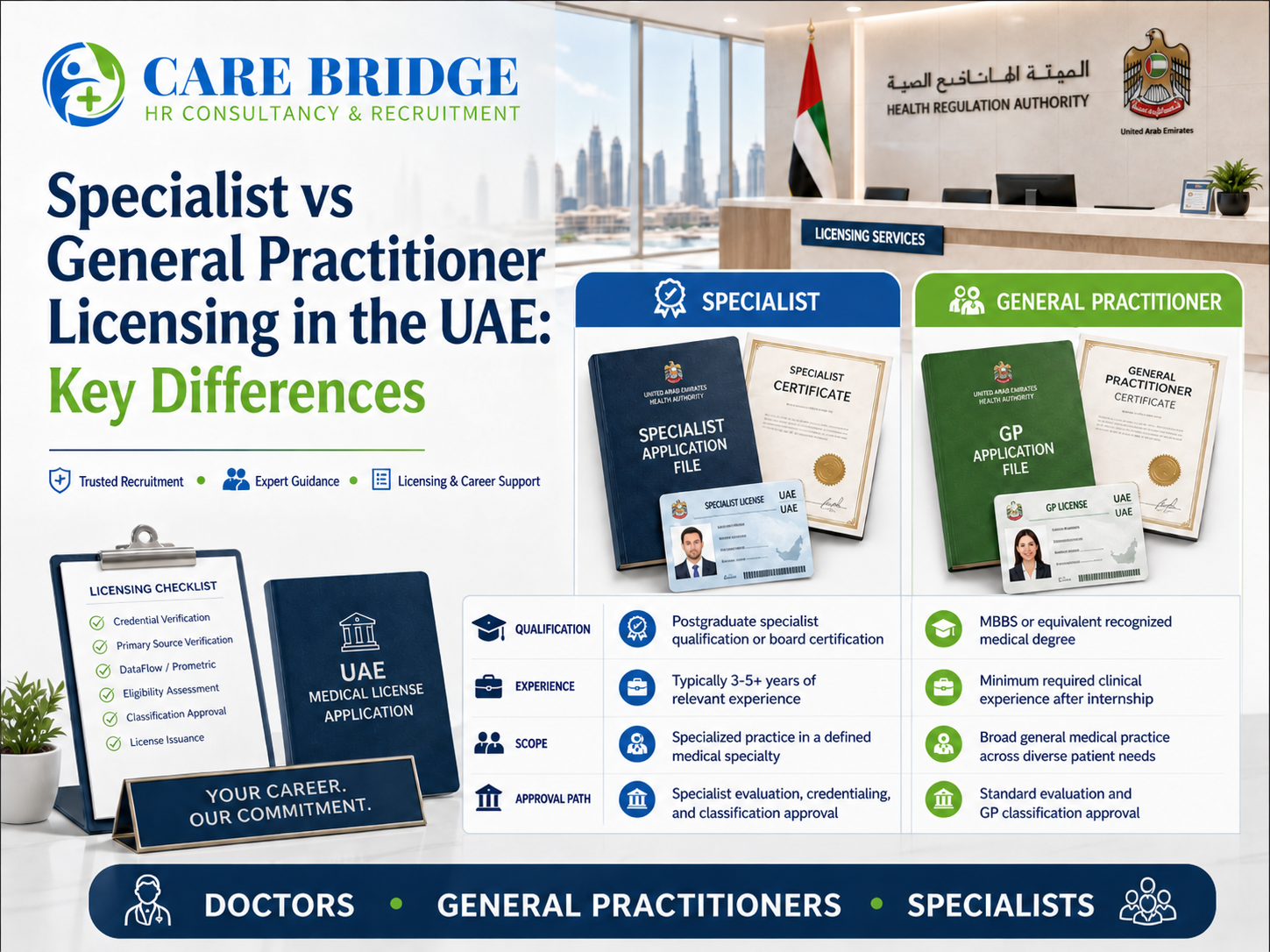
Specialist vs General Practitioner Licensing in the UAE: Key Differences
Healthcare professionals often ask one key question before applying in the UAE: Do I qualify as a Specialist or a General Practitioner? The answer shapes much more than the title on the application. It affects your licensing route, salary expectations, job scope, and the employers who will consider your profile.
In the UAE, regulators do not assign physician titles based on personal preference or informal job descriptions from another country. They assess qualifications and experience against formal standards. The Department of Health’s official Professional Qualification Requirement framework explains that the PQR document provides the base for assessing educational standards, experience, and licensure requirements for healthcare professionals across UAE jurisdictions. Dubai Health Authority services also state that registration confirms the professional meets the requirements for the applied position, including category, title, and specialty.
That is why early title assessment matters. A wrong choice can slow the application, reduce your job options, or place you in a lower-value route than your credentials support. Care Bridge’s healthcare licensing support page makes the same point in practical terms. It presents GCC licensing as a process that demands precision, regulatory knowledge, and compliance from the start. Care Bridge’s homepage also explains that the company supports specialist recruitment, licensing guidance, and compliant onboarding across the GCC.
Why physician classification matters in the UAE
Physician classification is not just a label. It decides the standards you must meet and the roles you can pursue. A General Practitioner and a Specialist are both physicians, but they do not enter the UAE licensing system through the same route. The DHA PQR document sets distinct physician title requirements, and DHA’s registration service makes clear that the authority evaluates the applied title and specialty as part of registration.
Employers follow the same structure. A clinic hiring for broad outpatient care may look for a GP. A hospital building a specialty line usually wants a physician who qualifies as a Specialist under the relevant framework. That difference affects the job market in a direct way. Care Bridge’s Frequently Asked Questions page shows that the firm supports physician and allied health recruitment, licensing, and timeline planning across the GCC. Its About Care Bridge page also notes that the company recruits across levels, from general practice to senior specialist leadership.
In simple terms, correct classification helps you apply for the right jobs, negotiate from a stronger position, and avoid setbacks before the file reaches final review.
What qualifies someone as a General Practitioner?
A General Practitioner title usually applies to a doctor who has completed a basic medical degree, internship, and the required clinical experience, but has not completed a recognized postgraduate specialty qualification. The DHA PQR states that physicians applying for the General Practitioner title must complete a medical degree of at least five years, excluding internship. Search results from the same PQR also show that the physician table separates GP from Specialist as a distinct title category.
This route often fits doctors working in primary care, general outpatient settings, urgent care-style environments, or broad clinic-based roles. It is the common path for physicians who practise general medicine without a recognized specialty credential that matches the UAE title rules.
Another detail matters here. The DOH-linked PQR material and related official documents show that some graduates from UAE universities may benefit from specific experience exemptions within defined conditions and timeframes. That means two doctors with similar basic medical degrees may not enter under identical eligibility rules. Graduation location, nationality category, internship timing, and post-graduation experience can all influence the route.
For that reason, no doctor should assume that a prior job title from another country will automatically convert into the same title in the UAE.
What qualifies someone as a Specialist?
A Specialist title requires more than an undergraduate medical degree and routine clinical work. In the UAE framework, the title depends on a recognized postgraduate specialty qualification first. After that, the authority looks at the experience attached to that qualification. The DHA PQR identifies Specialist as a separate physician category and ties the title to recognized specialty credentials listed in the wider framework. The DOH PQR page also confirms that the unified document serves as the reference point for educational, experience, and licensure assessment.
This is where many applicants misread their position. Some doctors believe that long general experience alone can make them eligible as Specialists. The UAE framework does not work that way. Authorities want to see a recognized postgraduate specialty qualification, board pathway, or equivalent credential accepted under the PQR structure. Only then do they assess the related specialty experience.
That difference carries major career implications. Specialists often move into narrower discipline-based roles such as internal medicine, pediatrics, dermatology, radiology, or cardiology. By contrast, GPs usually stay within broad general medical roles unless further qualifications change their title route. Because of that narrower scope and deeper formal training, specialists often receive stronger salary offers and more specialized employer interest. This recruitment reality aligns with Care Bridge’s public positioning as a firm focused on structured physician recruitment across titles and levels.
The key difference between GP and Specialist titles
The clearest distinction is simple. A General Practitioner qualifies through the primary medical degree, internship, and required general clinical experience. A Specialist qualifies through the primary medical degree plus a recognized postgraduate specialty qualification, together with any required specialty experience under the official framework. DHA’s PQR and the DOH PQR guidance both support that distinction.
That regulatory gap then shapes the employment market. GPs usually fit primary care, clinic, and broad outpatient roles. Specialists fit specialty-led departments, discipline-based services, and employer needs tied to defined clinical expertise. This is one reason the title matters so much before the application begins. It is not just about getting licensed. It is about entering the right part of the market.
A wrong classification can create three major problems. First, it can delay the application if the authority asks for clarification or reclassifies the file. Second, it can reduce your earning potential if you apply below your real level. Third, it can lead to rejection if you apply under a title your qualifications do not support. Care Bridge’s healthcare licensing support page stresses structured planning for exactly this reason. Licensing accuracy affects both approval and recruitment outcomes.
How doctors should assess their title early
Start with the official framework, not with a recruiter’s guess or a hospital advertisement. Review your basic medical degree, internship completion, postgraduate specialty certificate, and post-qualification experience against the official DOH PQR page and the relevant DHA PQR document. Those sources define the rules that matter during licensing review.
Next, assess the recruitment side. Ask which roles actually match your formal title pathway. That is where support from a sector-focused firm can help. Care Bridge’s Frequently Asked Questions page shows that the company supports licensing, timelines, and recruitment planning for professionals moving into GCC healthcare roles.
Then prepare your documents with the title in mind. Internship proof, specialty certificates, license history, and clearly dated experience letters all help the authority assess the correct pathway faster.
FAQ: Specialist vs General Practitioner licensing in the UAE
What is the main difference between a GP and a Specialist in UAE licensing?
The main difference is the qualification route. A GP usually qualifies through the primary medical degree, internship, and required general experience. A Specialist must also hold a recognized postgraduate specialty qualification under the official DHA PQR and the wider DOH PQR framework.
Can years of experience alone make me a Specialist?
No. UAE authorities do not rely on years of general experience by themselves. They first look for a recognized specialty qualification and then assess the experience linked to that qualification through the PQR framework.
Do Specialists usually receive better salary offers than GPs?
In many cases, yes. Specialists often access narrower clinical roles and stronger salary packages because employers recruit them for title-specific services. Care Bridge’s About Care Bridge page reflects this market structure by describing recruitment across physician levels and specialties.
Can the wrong classification delay my application?
Yes. Applying under the wrong title can trigger clarification requests, reclassification, or rejection. DHA’s registration service guidance confirms that category, title, and specialty form part of the registration assessment.
What should I check before choosing GP or Specialist?
Check your internship status, recognized postgraduate qualifications, and relevant post-qualification experience against the official DHA PQR document and the DOH PQR page. That gives you the strongest basis for choosing the correct route.
Conclusion
Understanding whether you qualify as a General Practitioner or a Specialist is one of the most important early decisions in the UAE licensing journey. It affects your regulatory pathway, your employer fit, your salary potential, and the speed of your application.
The safest approach is to review your title early against official UAE requirements and then build your licensing strategy around that evidence. Doctors who do that reduce avoidable delays and position themselves more accurately in the market. That is where Care Bridge Human Resource Consultancies adds real value. Its healthcare licensing support page and public recruitment positioning show a compliance-led approach that connects licensing accuracy with practical career planning.