




GCC Healthcare Licensing Comparison Guide: UAE, Saudi Arabia, Qatar, and Oman
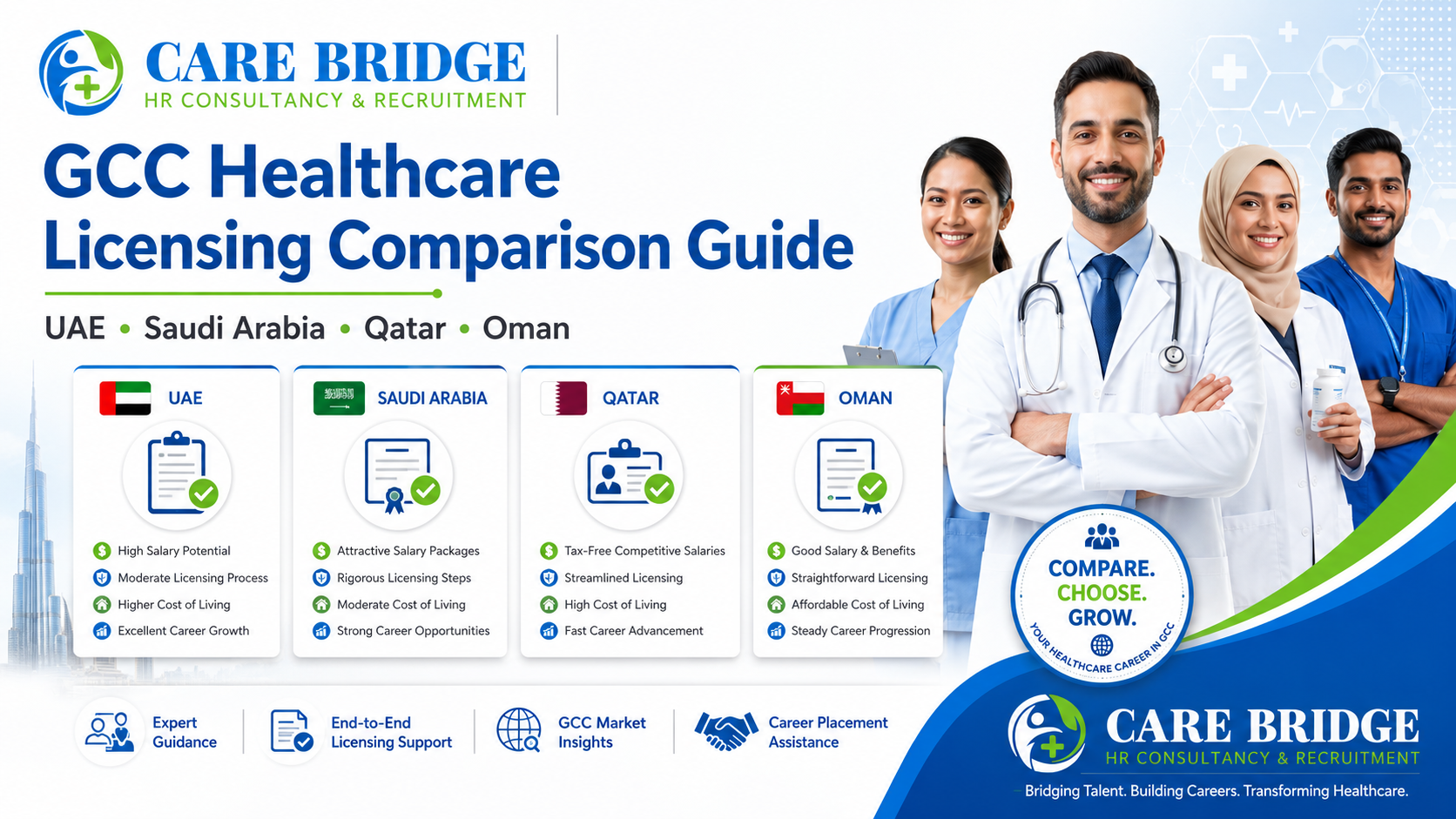
Healthcare professionals who want to build a career in the GCC often compare the UAE, Saudi Arabia, Qatar, and Oman before choosing where to practise. Each country offers strong opportunities, modern healthcare facilities, international exposure, and career growth. However, each country also has a different licensing system, document process, employer structure, and lifestyle profile.
Choosing the right country should not depend on salary alone. A higher package may look attractive, but licensing delays, cost of living, family needs, exam requirements, and employer expectations can affect the overall value of the move. A strong decision should balance four major factors: licensing difficulty, salary expectations, cost of living, and long-term career progression.
Care Bridge Human Resource Consultancies supports doctors, nurses, dentists, pharmacists, and allied health professionals with GCC recruitment, licensing guidance, document preparation, and employer coordination. This guide compares the main healthcare licensing systems across the UAE, Saudi Arabia, Qatar, and Oman so professionals can plan their next career move with more clarity.
Why GCC Licensing Comparison Matters
Healthcare licensing protects patients and ensures that professionals meet recognised standards before they practise. Across the GCC, regulators review qualifications, experience, professional registration, verification records, and sometimes examination results.
At first glance, GCC licensing systems may look similar. Most require academic documents, professional licenses, experience letters, good standing records, primary source verification, and exams where required. However, the route differs by country.
The UAE has multiple authorities depending on the emirate. Saudi Arabia uses a more centralised system through SCFHS. Qatar uses the Department of Healthcare Professions under the Ministry of Public Health. Oman involves the Ministry of Health and Oman Medical Specialty Board-related pathways depending on the category and process.
Professionals who understand these differences can avoid delays, choose realistic job targets, and prepare stronger applications. CareBridge also supports candidates through healthcare licensing services across the GCC for UAE, Saudi Arabia, Qatar, Oman, and other regional pathways.
UAE Healthcare Licensing: Multiple Authorities by Location
The UAE is one of the most popular healthcare destinations in the Gulf. It offers strong private-sector opportunities, modern hospitals, international clinics, and a multicultural lifestyle. However, the UAE licensing system depends on where the professional will work.
Dubai professionals usually follow DHA. Abu Dhabi professionals follow DOH. Many Northern Emirates roles may fall under MOHAP. Dubai Healthcare City roles may require DHCC licensing. This means a healthcare professional must identify the correct authority before applying.
Dubai’s DHA registration service confirms that registration shows the applicant meets the requirements for the applied category, title, and specialty. A healthcare facility must then activate the registration into a license before the professional can practise through the official DHA healthcare professional registration service.
The UAE suits professionals who want a dynamic healthcare environment, strong private-sector exposure, and international lifestyle options. However, licensing pathways vary. A doctor applying as a General Practitioner will follow different requirements from a Specialist or Consultant. CareBridge explains these title differences in its guide on Specialist vs General Practitioner licensing in the UAE.
Saudi Arabia Healthcare Licensing: Centralised SCFHS Pathway
Saudi Arabia has one of the largest healthcare markets in the GCC. The Kingdom continues to expand hospitals, specialist centres, digital health services, and large-scale healthcare transformation projects. It attracts consultants, specialists, nurses, pharmacists, and allied health professionals from many countries.
Saudi healthcare licensing usually runs through the Saudi Commission for Health Specialties, known as SCFHS. Professionals use Mumaris Plus for many practitioner services. SCFHS explains that professional registration includes logging into Mumaris Plus, completing application data, uploading documents, reviewing information, paying fees, and submitting the registration application through the official SCFHS professional registration service.
Saudi Arabia has a more centralised licensing model than the UAE. This can make the pathway clearer in structure, but classification standards can be strict. SCFHS reviews the professional’s qualifications, training, experience, and category before confirming classification and registration.
Saudi Arabia may suit professionals who want large hospital systems, consultant-level opportunities, strong packages in selected specialties, and long-term career growth. It may also offer attractive benefits for senior roles, including housing, flights, medical insurance, and family support depending on the employer.
Professionals comparing salary and benefits across the region can review CareBridge’s guide on healthcare salary comparison between the UAE and Saudi Arabia.
Qatar Healthcare Licensing: DHP Registration and Verification
Qatar offers a growing healthcare market with modern facilities, specialist services, and competitive employment opportunities. Doha attracts healthcare professionals who want GCC experience in a well-regulated and developing healthcare system.
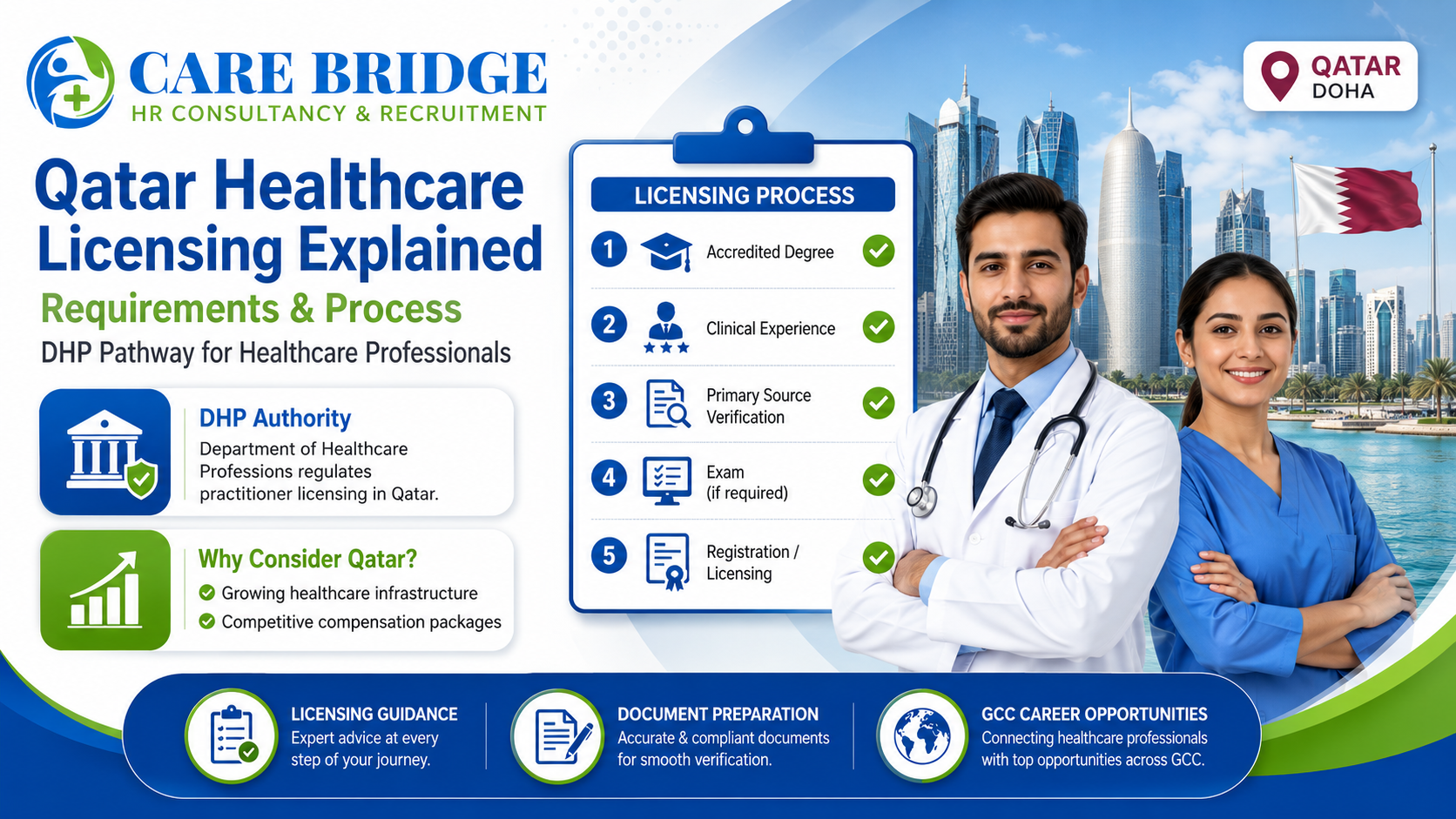
Qatar healthcare licensing runs through the Department of Healthcare Professions, known as DHP, under the Ministry of Public Health. DHP reviews qualifications, experience, registration status, primary source verification, and exam requirements.
Primary source verification plays a major role. Qatar DHP states that DataFlow and Quadrabay are approved service providers for primary source verification of documents for healthcare practitioners as a mandatory requirement for registration and licensing through the official DHP primary source verification page.
Qatar may suit professionals who want a smaller but advanced GCC market, strong urban infrastructure, family-friendly living, and competitive packages. However, candidates should confirm whether their category requires an exam, whether their experience meets DHP expectations, and whether their documents are ready for verification.
CareBridge’s Qatar healthcare licensing guide explains the DHP pathway in more detail for professionals considering Qatar.
Oman Healthcare Licensing: Ministry of Health and OMSB Pathways
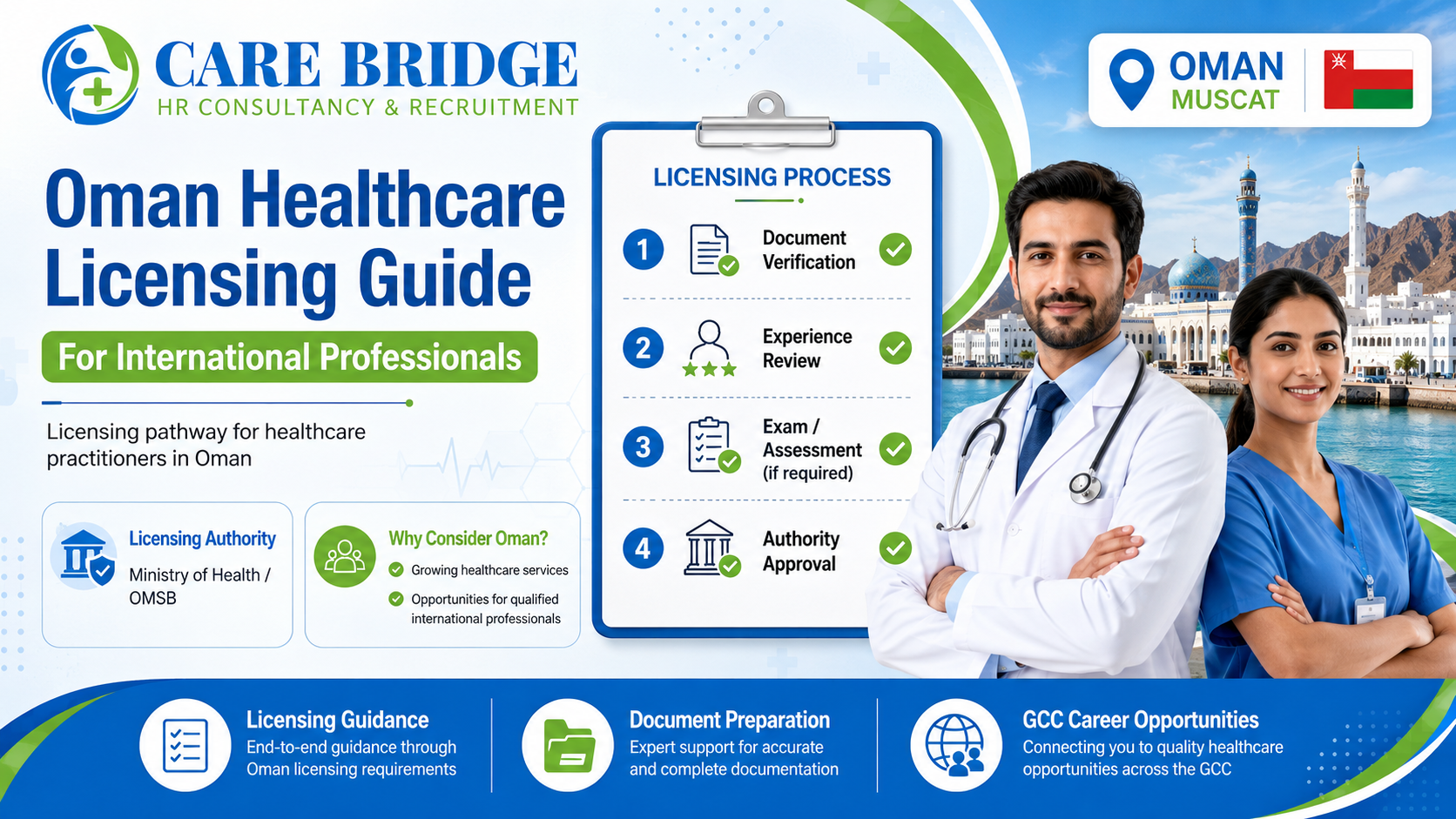
Oman offers a stable healthcare environment, growing healthcare services, and a lifestyle that may appeal to professionals who prefer a calmer GCC setting. Muscat and other regions continue to develop healthcare facilities and specialist services.
Oman licensing may involve the Ministry of Health and Oman Medical Specialty Board-related processes depending on the professional category and employer route. The process usually includes document verification, experience review, examination or assessment where required, and authority approval.
OMSB states that Primary Source Verification confirms documents directly from the original source and helps verify qualifications, experience certificates, and professional licenses. Verification is mandatory for Omanis and non-Omanis who obtained qualifications outside Oman through the OMSB Primary Source Verification service.
Oman may suit healthcare professionals who want GCC experience, steady career development, and a balanced lifestyle. However, candidates should still prepare documents carefully. Missing experience letters, expired licenses, unclear certificates, or mismatched titles can delay the application.
Professionals comparing Oman with other GCC pathways can review CareBridge’s Oman healthcare licensing guide for international professionals.
Licensing Difficulty: Which Country Is Easier?
No GCC country is automatically “easy” for every professional. Licensing difficulty depends on profession, title, qualifications, experience, verification history, and employer support.
The UAE can feel complex because the authority changes by emirate. A candidate must know whether DHA, DOH, MOHAP, or DHCC applies. Saudi Arabia can feel strict because SCFHS classification reviews professional levels carefully. Qatar can require strong verification and category-specific assessment. Oman can require careful document matching and authority approval.
The best approach is to assess eligibility before applying. Professionals should not assume that one GCC license automatically transfers to another country. A UAE license may support a Saudi, Qatar, or Oman application, but it does not replace local authority approval.
CareBridge helps candidates avoid guesswork by reviewing licensing history, documents, professional title, and target market before submission.
Salary, Cost of Living, and Lifestyle Differences
Salary matters, but it should not be the only deciding factor. The UAE may offer strong private-sector opportunities and international lifestyle benefits, but Dubai and Abu Dhabi can have higher living costs. Saudi Arabia may offer strong consultant packages and larger hospital systems, especially in government-linked or major private institutions. Qatar may provide competitive packages in a smaller market with strong infrastructure. Oman may offer a more balanced lifestyle and stable work environment, depending on employer and role.
Cost of living also affects savings. Housing, schooling, transport, family visas, health insurance, and annual flights can change the real value of an offer. A slightly lower salary with housing and family benefits may offer better savings than a higher salary without allowances.
Healthcare professionals should compare the total package, not only the monthly salary. They should ask about working hours, shifts, on-call duties, overtime, annual leave, relocation support, medical insurance, probation terms, and licensing fees.
For practical planning, candidates can use CareBridge’s UAE and GCC licensing document checklist before applying across multiple countries.
Career Progression Across the GCC
Career progression depends on the healthcare system, employer type, and professional category. Saudi Arabia may offer strong opportunities in large tertiary hospitals, specialist centres, and transformation projects. The UAE may support professionals who want private-sector growth, international patient exposure, and fast-moving clinical environments. Qatar may suit candidates seeking structured roles in a growing healthcare system. Oman may suit professionals who value stability and long-term development.
Doctors should compare how each country recognises GP, Specialist, and Consultant pathways. Nurses should compare scope, department structure, and promotion opportunities. Allied health professionals should review whether their specialty has strong demand in the target market.
The strongest career decision balances licensing feasibility, salary, employer reputation, lifestyle, and long-term development.
How CareBridge Supports GCC Licensing Decisions
Care Bridge Human Resource Consultancies helps healthcare professionals compare GCC options before they commit to a role. This support reduces confusion and helps candidates choose a country that matches their profile and goals.
CareBridge supports professionals with:
- UAE, Saudi Arabia, Qatar, Oman, Kuwait, and Bahrain licensing guidance
- Document review and preparation
- Primary source verification support
- Professional category assessment
- Recruitment and employer coordination
- Interview preparation
- Relocation and onboarding guidance
Candidates searching for regional roles can review CareBridge healthcare job openings and align applications with realistic licensing timelines.
FAQ: GCC Healthcare Licensing Comparison
1. Which GCC country has the easiest healthcare licensing process?
There is no single easiest option. The process depends on your profession, qualifications, experience, documents, and target title. A candidate may qualify smoothly in one country but face extra requirements in another.
2. Can I use my UAE license in Saudi Arabia, Qatar, or Oman?
A UAE license may support your professional history, but it does not replace local approval. Saudi Arabia requires SCFHS classification and registration. Qatar requires DHP approval. Oman requires the correct Ministry of Health or OMSB-related pathway.
3. Which country offers the best healthcare salaries?
It depends on specialty, employer, seniority, and benefits. Saudi Arabia may offer strong consultant packages. The UAE may offer high private-sector variability. Qatar can offer competitive packages. Oman may offer stable opportunities with a balanced lifestyle.
4. Do all GCC countries require DataFlow or primary source verification?
Most GCC licensing pathways require some form of credential verification. The provider and process vary by country and authority. Candidates should confirm requirements before submitting documents.
5. Should I choose a country before starting licensing?
Yes. You should identify your target country and professional title before paying fees or starting verification. This helps avoid duplicate costs and incorrect applications.
6. Can CareBridge help me compare GCC licensing options?
Yes. CareBridge supports healthcare professionals with GCC licensing guidance, document review, recruitment matching, and employer coordination. This helps candidates choose the right country and prepare stronger applications.
Conclusion
Choosing where to practise in the GCC requires more than comparing salaries. Healthcare professionals should assess licensing difficulty, cost of living, employer benefits, lifestyle, career progression, and document readiness before making a decision.
The UAE offers multiple authority pathways and strong private-sector opportunities. Saudi Arabia offers a centralised SCFHS system and major healthcare growth. Qatar provides a structured DHP licensing route in a developing healthcare market. Oman offers stable opportunities and a balanced professional environment.
Care Bridge Human Resource Consultancies helps healthcare professionals compare these options with clarity. Through licensing support, recruitment guidance, document preparation, and employer coordination, CareBridge helps candidates move toward the GCC healthcare career that best matches their goals.