




How to Prepare a Strong DHA CV for Healthcare Professionals
A strong DHA CV can improve your chances of securing interviews, completing licensing steps, and joining a healthcare employer in Dubai with fewer delays. For doctors, nurses, dentists, pharmacists, physiotherapists, and allied health professionals, the CV is not only a recruitment document. It also helps employers understand your licensing readiness, clinical background, specialty focus, and professional pathway.
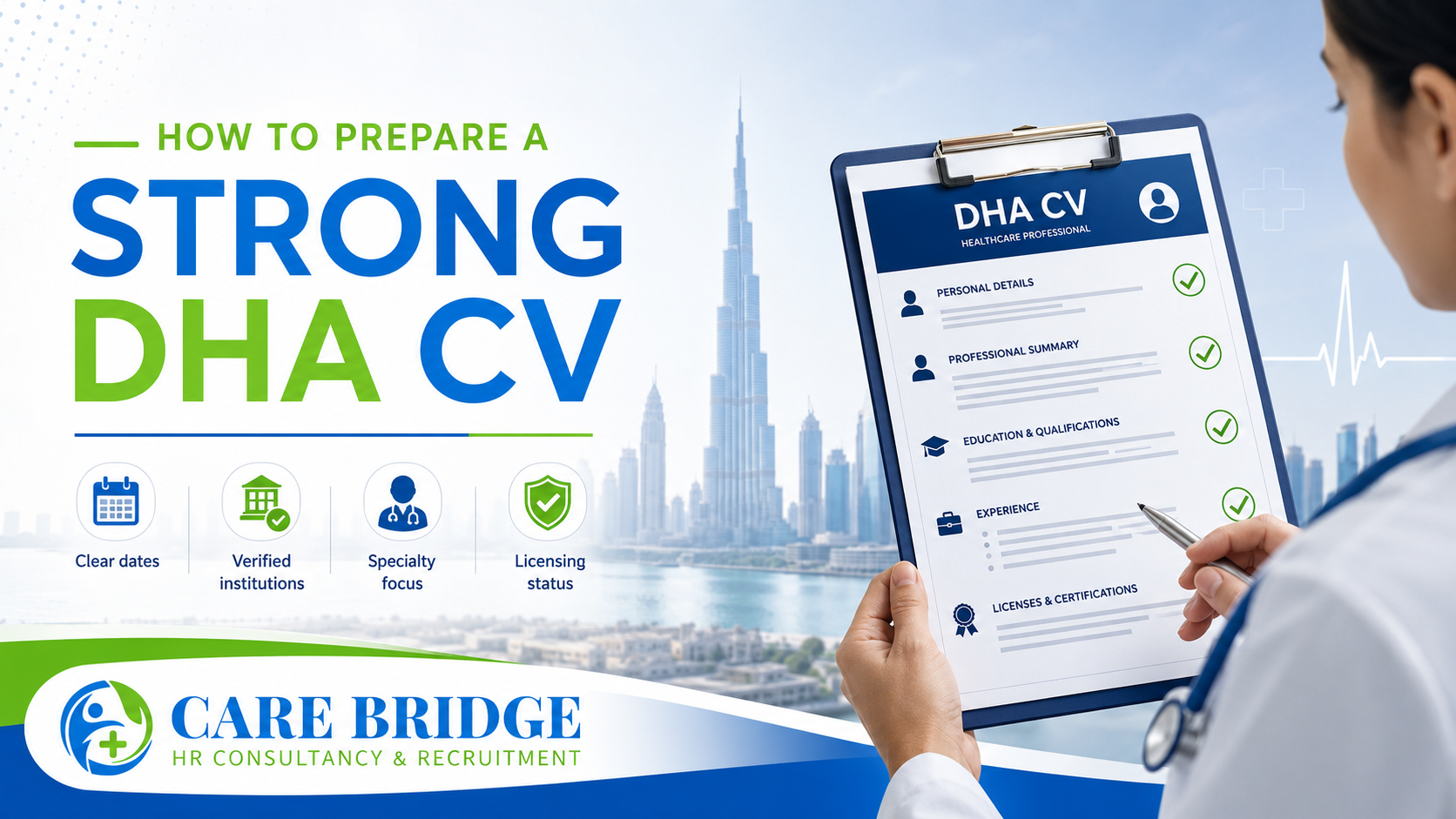
Many healthcare professionals prepare a general CV and use it for every job application. However, Dubai healthcare recruitment requires more structure. A DHA-ready CV should show clear employment dates, verified institutions, relevant clinical duties, licensing status, and specialty experience. It should also match your documents, including experience letters, professional registrations, degree certificates, and DataFlow records.
A clear understanding of how to prepare a strong DHA CV helps candidates avoid confusion during recruitment and licensing. Care Bridge Human Resource Consultancies supports healthcare professionals with UAE licensing guidance, CV readiness, document review, job matching, and employer coordination.
This guide explains how to prepare a strong DHA CV, what employers and licensing teams look for, and how to make your profile more suitable for Dubai healthcare opportunities.
Why a DHA-Ready CV Matters
A DHA-ready CV matters because it connects recruitment and licensing. Employers use your CV to decide whether your experience matches the role. Licensing teams also rely on the same information to compare your professional history with your supporting documents.
Dubai Health Authority explains that professional registration confirms that the applicant meets the requirements for the applied category, title, and specialty. The registration is valid for one year, and a healthcare facility must activate it into a license before the professional can start practising through the official DHA healthcare professional registration service.
Therefore, your CV should support the category, title, and specialty you want to apply for. If your CV is unclear, employers may struggle to assess your profile. In addition, licensing delays may happen when your CV does not match your experience letters or professional records.
Healthcare professionals who need wider support with licensing can review CareBridge’s healthcare licensing services for DHA, DOH, MOHAP, and GCC pathways.
How to Prepare a Strong DHA CV: Start With Clear Structure
The first step in learning how to prepare a strong DHA CV is to use a clean and professional structure. Keep the layout simple. Avoid decorative designs, long paragraphs, images, or unnecessary colours. Healthcare employers and licensing support teams need clarity, not visual complexity.
Your DHA-ready CV should include:
- Full name as per passport
- Contact details and current location
- Professional title
- Licensing status
- Summary profile
- Core clinical skills
- Employment history
- Education and qualifications
- Professional licenses and registrations
- Certifications and training
- DataFlow or verification status, if available
- Languages
- References, if requested
Use reverse chronological order for employment and education. This means your latest role should appear first. Also, use consistent formatting for dates. For example, use “January 2022 – March 2025” instead of mixing different date styles.
A clear structure helps employers review your profile faster. It also reduces the chance of questions later.
Include Clear Employment Dates
Employment dates are one of the most important parts of a DHA CV. Employers and licensing teams need to see when and where you worked. They also need to understand whether your experience is recent, relevant, and continuous.
Use month and year for every role. Do not write only the year. For example, “2020–2023” is less useful than “March 2020 – July 2023.” If there is an employment gap, do not hide it. Instead, keep the dates accurate and explain the gap if needed during the recruitment process.
Your employment dates should match your experience letters. If your CV says you worked until June 2024 but your experience letter says April 2024, the mismatch may create questions. In some cases, it may delay document verification or employer onboarding.
CareBridge’s UAE licensing document checklist can help candidates compare their CV against key licensing documents before submission.
Mention Verified Institutions Clearly
A strong DHA CV should name every employer, hospital, clinic, university, and licensing body clearly. Avoid abbreviations unless the institution is widely recognised. Also, include the country and city where the institution is located.
For example, instead of writing “City Hospital,” write “City Hospital, Lahore, Pakistan” or “City Hospital, London, United Kingdom.” This helps employers and verification teams understand your background.
DataFlow states that it collaborates with Dubai Health Authority to screen the credentials of healthcare professionals working within Dubai’s healthcare sector through the DHA DataFlow verification pathway. Because verification may involve checking institutions directly, your CV should use accurate names and consistent details.
If an institution has changed its name, mention the current name and previous name where appropriate. This can help avoid confusion during verification.
Show Your Specialty Focus
Your DHA CV should make your specialty focus easy to understand. This is especially important for doctors, dentists, nurses, and allied health professionals applying for specific clinical roles.
For doctors, the CV should clearly show whether you are applying as a General Practitioner, Specialist, or Consultant. For nurses, it should highlight department experience such as ICU, emergency, operating theatre, paediatrics, maternity, dialysis, homecare, or outpatient care. For dentists, it should show general dentistry or specialty exposure. For physiotherapists, it should highlight musculoskeletal, neurological, sports, paediatric, rehabilitation, or homecare experience where relevant.
Do not list every duty from every role. Instead, focus on duties that support your target role in Dubai. For example, a specialist applicant should highlight specialty clinics, procedures, case exposure, diagnostic responsibilities, multidisciplinary work, and clinical outcomes.
Candidates comparing professional titles can review CareBridge’s guide on Specialist vs General Practitioner licensing in the UAE before finalising their CV.
Add Your Licensing Status
Employers want to know your licensing status early. Therefore, your CV should include a short licensing section near the top or after the profile summary.
You can include details such as:
- DHA eligibility status
- DHA license status
- DHA exam passed, if applicable
- DataFlow completed or in progress
- Previous UAE license, if any
- Home country registration
- Good Standing Certificate status
- Other GCC licensing status, if relevant
Be honest and specific. Do not write “DHA license completed” if you only have eligibility. DHA registration or eligibility may still need facility activation before practice. DHA’s professional services page also explains that a healthcare career in Dubai starts with obtaining a registration and then activating it into a license to practise through Sheryan, the Dubai Health Licensing System.
If you are unsure how licensing connects with employment and visa steps, CareBridge’s article on visa and healthcare licensing in the UAE explains the sequence.
Match Your CV With Supporting Documents
Your CV must match your supporting documents. This is one of the most important rules in DHA recruitment and licensing preparation.
Check that your CV matches:
- Passport name
- Degree certificate name
- Professional license name
- Experience letter dates
- Job titles
- Facility names
- Country and city details
- Specialty certificates
- Training certificates
- Good Standing Certificate information
Even small inconsistencies can create questions. For example, if your CV says “Senior Staff Nurse” but your experience letter says “Registered Nurse,” the employer may ask for clarification. If your CV says “Specialist Dermatologist” but your license says “Medical Officer,” the title mismatch may affect your application.
Before applying, review every document carefully. In addition, keep scanned copies clear and readable. Poor-quality scans can slow down both recruitment and licensing review.
Write a Strong Professional Summary
Your CV summary should be short, focused, and relevant to the UAE role. Avoid generic statements such as “hardworking professional seeking growth.” Instead, mention your profession, years of experience, specialty area, and licensing status.
Example:
“Registered Nurse with six years of ICU experience across tertiary hospital settings, with strong exposure to critical care monitoring, ventilated patients, infection control, and multidisciplinary teamwork. DataFlow completed and preparing for DHA licensing pathway.”
This type of summary helps employers understand your value quickly. It also gives recruiters a clear reason to continue reading.
Keep the summary to three or four lines. Long summaries often reduce readability.
Use Active, Specific Bullet Points
A DHA CV should use active bullet points. Start each point with a strong verb and show what you actually did.
Instead of writing:
“Responsible for patient care.”
Write:
“Managed daily nursing care for post-operative patients, including medication administration, wound monitoring, escalation, and documentation.”
Instead of writing:
“Worked in physiotherapy department.”
Write:
“Assessed musculoskeletal patients, created rehabilitation plans, delivered therapy sessions, and documented progress in patient records.”
Specific details show clinical relevance. They also help employers match your experience to the role.
Keep the CV Professional and Concise
Most healthcare CVs should be two to four pages, depending on seniority. A senior consultant may need more space than a junior nurse, but the CV should still remain focused.
Avoid unrelated personal details. Do not include passport number, salary expectations, marital status, religion, or full home address unless an employer specifically requests it. Also, avoid excessive design elements, tables that do not copy well, or photos unless requested.
Use simple headings and consistent spacing. Moreover, save the file with a professional name, such as:
Dr-Aisha-Khan-DHA-CV.pdf
Registered-Nurse-Maria-Santos-DHA-CV.pdf
A clear file name makes it easier for recruiters and employers to manage your profile.
Common Mistakes to Avoid
Many candidates lose opportunities because their CV creates confusion. Common mistakes include unclear dates, missing employer locations, unsupported specialty claims, outdated licensing status, and employment details that do not match experience letters.
Another mistake is submitting the same CV for every role. A physiotherapist applying to a sports rehabilitation clinic should highlight different experience from someone applying to a homecare provider. Likewise, a dentist applying to a cosmetic clinic should highlight relevant procedures, patient volume, and dental software exposure where appropriate.
Do not exaggerate. Employers may ask clinical questions during interviews, and licensing teams may check records. A truthful and well-structured CV is stronger than an inflated one.
Professionals looking for suitable roles can review CareBridge healthcare job openings and align their CV with realistic employer requirements.
How CareBridge Supports DHA CV Preparation
Care Bridge Human Resource Consultancies helps healthcare professionals prepare CVs that support recruitment and licensing goals. The team understands the link between CV details, documents, licensing pathways, and employer expectations.
CareBridge can support candidates with:
- DHA CV structure guidance
- Employment date and document matching
- Licensing status review
- Specialty-focused CV improvement
- Interview preparation
- Employer coordination
- UAE and GCC healthcare recruitment support
This support helps candidates present a clearer profile. As a result, employers can assess suitability faster, and licensing preparation becomes more organised.
FAQ: How to Prepare a Strong DHA CV
1. What should a DHA-ready CV include?
A DHA-ready CV should include clear employment dates, verified institution names, professional title, licensing status, clinical experience, education, professional registration, certifications, and relevant specialty focus.
2. Should I mention my DHA eligibility on my CV?
Yes. If you have DHA eligibility, exam results, DataFlow status, or an active license, mention it clearly. However, do not describe eligibility as an active license unless the facility has activated it.
3. Why do employment dates matter for DHA licensing?
Employment dates help employers and licensing teams assess whether your experience is recent, relevant, and consistent with your experience letters. Dates should include month and year.
4. Should my CV match my experience letters?
Yes. Your CV should match your experience letters, professional licenses, education certificates, and verification records. Mismatches can cause recruitment or licensing delays.
5. How long should a DHA CV be?
Most DHA CVs should be two to four pages. Senior doctors or consultants may need more space, but the CV should stay focused, clear, and relevant.
6. Can CareBridge help me prepare a DHA CV?
Yes. CareBridge supports healthcare professionals with DHA CV preparation, licensing guidance, document review, recruitment coordination, and interview preparation for UAE healthcare roles.
Conclusion
Learning how to prepare a strong DHA CV can improve recruitment outcomes and reduce licensing confusion. A strong CV should show clear employment dates, verified institutions, specialty focus, accurate licensing status, and document consistency.
Healthcare professionals should treat the CV as both a recruitment tool and a licensing support document. It should match experience letters, professional registrations, qualifications, and DataFlow records. In addition, it should help employers understand the candidate’s clinical value quickly.
Care Bridge Human Resource Consultancies helps healthcare professionals prepare stronger DHA CVs, organise documents, understand licensing status, and connect with suitable UAE healthcare employers. With a clear and accurate CV, candidates can improve their chances of securing interviews and moving through the DHA pathway with more confidence.