







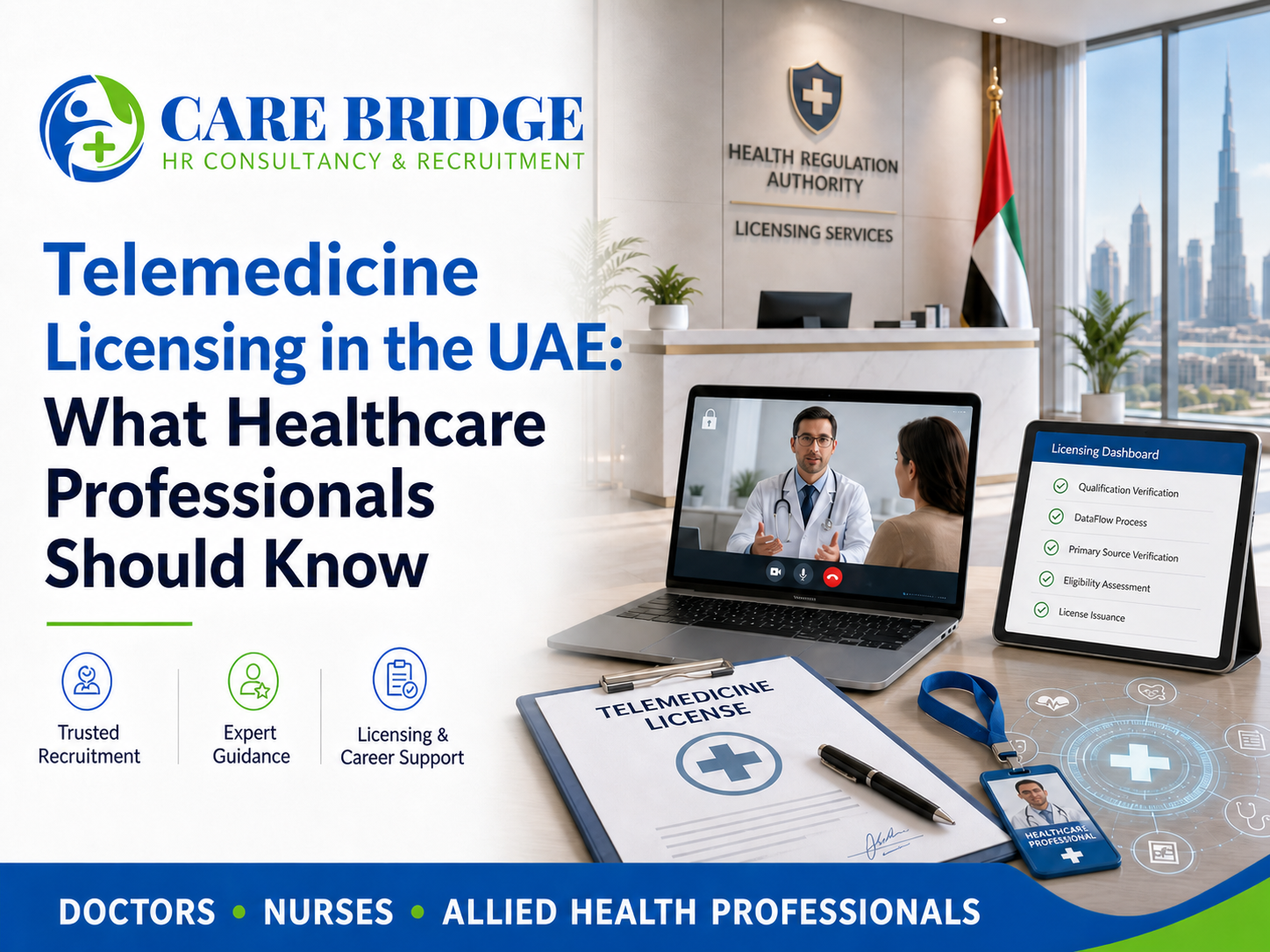
Telemedicine Licensing in the UAE: What Healthcare Professionals Should Know
Telemedicine now plays a major role in healthcare across the UAE. Patients want faster access to care. Providers want more flexible service delivery. Regulators have responded with clearer digital health rules. That creates real opportunity for healthcare professionals, but it also raises the bar for compliance.
Healthcare professionals cannot treat telemedicine as a casual extension of normal practice. In the UAE, remote care is allowed, but regulators control how it is delivered. The UAE government says telemedicine services are available through approved channels, while Dubai Health Authority publishes dedicated telehealth regulations, standards, and clinical guidelines for licensed providers.
That is why healthcare professionals should understand the rules before offering remote consultations, online follow-ups, or digital prescribing. The right setup can expand access and improve continuity of care. The wrong setup can create licensing problems, employer issues, or data protection risks. Care Bridge Human Resource Consultancies takes that broader view. Its healthcare licensing support page presents UAE licensing as a structured process that depends on regulatory accuracy, documentation control, and authority-specific planning. Care Bridge’s homepage also explains that it supports specialist recruitment, licensing guidance, relocation, and compliant onboarding across the GCC.
Is telemedicine allowed in the UAE?
Yes, telemedicine is allowed in the UAE. The more important point is that regulators control it closely.
At the federal level, the UAE built a legal framework for digital health and ICT-enabled healthcare. At the authority level, regulators set practical service standards. Dubai Health Authority’s official telehealth page includes a telehealth policy, telehealth standards, and clinical telehealth guidance. That structure shows something important: regulators do not treat telemedicine as an informal grey area. They treat it as a defined healthcare service model with rules, scope, and oversight.
So the real question is not only, “Can I do telemedicine?” The better question is, “Am I licensed correctly, working through an approved structure, and following the right rules for my authority and employer?” That is the safer starting point. Care Bridge’s DHA licensing guide supports the same approach. It shows that legal practice in Dubai depends on correct authority approval, proper title alignment, and step-by-step compliance.
What telemedicine licensing usually requires
A valid UAE healthcare license comes first. Telemedicine does not replace professional licensing. It sits on top of it. Dubai Health Authority’s Sheryan portal says healthcare professionals must first get registered and then activate that registration into a license to practise in Dubai. That means no professional should assume that digital care creates a shortcut around core licensing rules.
An approved healthcare facility or approved service model comes next. In practice, telemedicine in the UAE is usually tied to licensed providers and regulated service environments. Regulators focus on how the service is delivered, not only on the clinical act itself. That is why healthcare professionals should work through employer-approved pathways and compliant operational structures, not informal side arrangements.
Digital compliance also matters. Remote care depends on patient data, digital records, consultation systems, and secure communication. Professionals need systems that protect confidentiality, preserve clinical records, and fit regulatory expectations. If the technology is weak, the service model becomes risky, even if the clinical advice is sound.
This is where Care Bridge adds value beyond simple licensing paperwork. Its healthcare licensing support page frames GCC licensing as an end-to-end process that includes regulatory planning, document readiness, and compliant next steps. That wider view matters because telemedicine is still clinical practice. It just happens through a different delivery model.
Key compliance points healthcare professionals should not ignore
Data security comes first. Telemedicine depends on the collection, review, and storage of sensitive health information. That means healthcare professionals should use secure systems instead of relying on convenience tools or consumer messaging apps. A weak digital process can create a strong compliance risk.
Approved platforms matter as well. Not every video or chat tool is suitable for clinical care. Regulators care about the service environment, the quality controls, and the protection around the patient interaction. Professionals should therefore use platforms approved by their employer or built into the facility’s regulated telehealth workflow.
Patient confidentiality remains essential at every step. Remote care does not reduce professional duties. It increases the need for structure. Healthcare professionals must protect consultation privacy, secure records, and keep digital access controlled. That applies to follow-ups, virtual reviews, prescriptions, and stored communications.
Documentation also matters. A digital consultation still creates a clinical record. The format may differ from in-person practice, but the professional duty does not disappear. Notes, treatment decisions, patient advice, and follow-up instructions should remain clear and supportable. DHA’s telehealth framework makes it clear that telehealth sits inside a regulated service environment, not outside it.
Cross-emirate telemedicine: where many professionals get confused
This is one of the biggest problem areas in practice. Many healthcare professionals assume that a license in one emirate automatically lets them provide telemedicine anywhere in the UAE. That assumption can cause trouble.
UAE healthcare licensing has historically operated through separate authorities, including DHA, DOH, and MOHAP. The Department of Health’s official Professional Qualification Requirement framework explains that the PQR provides the base for assessing educational standards, experience, and licensure requirements for healthcare professionals working in UAE jurisdictions. In other words, a unified base exists, but authority-level pathways still matter in real practice.
Care Bridge explains this clearly in its article on Unified UAE Healthcare Licensing. The article notes that greater alignment is developing, but licensing still depends on preparation, compliance, and authority-specific execution. That matters for telemedicine because remote care can cross physical boundaries even when the digital interaction feels simple.
Employer permissions can matter. Facility approvals can matter. Authority rules can matter. Patient location can matter too. So before offering cross-emirate telemedicine, professionals should confirm their licensing position, their facility’s telehealth structure, and the operating rules that apply to the service model.
Why telemedicine is still a strong opportunity
Strong regulation should not scare professionals away from telemedicine. In fact, it signals that the model has become more established.
The UAE government highlights telemedicine through official public channels. Dubai Health Authority maintains a dedicated telehealth framework. Department of Health also continues to publish professional standards and regulatory guidance for healthcare practice in Abu Dhabi. That level of regulatory maturity gives licensed professionals a more stable environment in which to build digital health services.
For employers, telemedicine can support access, follow-up care, triage, chronic disease review, and specialist reach. For healthcare professionals, it can open new work models, more flexible schedules, and broader patient engagement. But those benefits only last when licensing and compliance are handled correctly.
Care Bridge’s healthcare licensing support page and DHA licensing guide both reinforce the same idea. Healthcare careers move more smoothly when professionals align the regulatory pathway before they start practice. That applies to digital care just as much as it applies to in-person work.
FAQ: Telemedicine licensing in the UAE
Is telemedicine legal in the UAE?
Yes. Telemedicine is legal in the UAE, and the UAE government’s official telemedicine overview confirms that telemedicine services are available through approved channels. Dubai Health Authority also maintains official telehealth regulations and standards, which shows that remote care is regulated rather than informal.
Do I need a UAE healthcare license to provide telemedicine?
Yes. Telemedicine does not replace professional licensing. DHA’s professional services portal states that healthcare professionals must first obtain registration and then activate it into a license to practise in Dubai. Care Bridge’s DHA licensing guide explains that this licensed status forms the base for legal practice.
Can I offer telemedicine independently from any platform?
Healthcare professionals should work through approved service models and compliant provider structures, not informal personal arrangements. DHA’s official telehealth regulations page shows that regulators expect telehealth services to operate under structured standards and policies.
Can I use telemedicine across different emirates with one license?
Not automatically. The official DOH PQR framework shows that UAE healthcare licensing still operates through authority-based assessment, even with a unified qualification base. Care Bridge’s Unified UAE Healthcare Licensing article explains why professionals should still check authority-specific rules before assuming cross-emirate flexibility.
What is the biggest compliance risk in telemedicine?
One of the biggest risks is assuming that remote care is less regulated than in-person care. In reality, professionals still need proper licensing, secure systems, approved service pathways, and strong confidentiality controls under the relevant telehealth and healthcare standards.
Conclusion
Telemedicine offers real flexibility and real opportunity in the UAE. It does not reduce the importance of licensing. It makes licensing and compliance even more important.
Healthcare professionals should confirm their UAE license status first. Then they should confirm the facility’s telehealth model, digital systems, and authority position. That order matters. It protects patient safety, supports legal practice, and reduces avoidable compliance problems.
That is the broader message for healthcare professionals entering digital care. New service models can create strong career opportunities, but only when the regulatory foundation is right. Care Bridge Human Resource Consultancies reflects that same compliance-first approach through its healthcare licensing support page, which focuses on authority-specific planning, licensing structure, and compliant professional pathways across the GCC.