




Oman Healthcare Licensing Guide for International Professionals
Oman continues to expand its healthcare services and welcomes qualified international professionals across hospitals, clinics, specialist centres, and allied health settings. For doctors, nurses, dentists, pharmacists, laboratory professionals, radiographers, physiotherapists, and other allied health professionals, Oman can offer a stable GCC career path with strong clinical exposure and a balanced lifestyle.
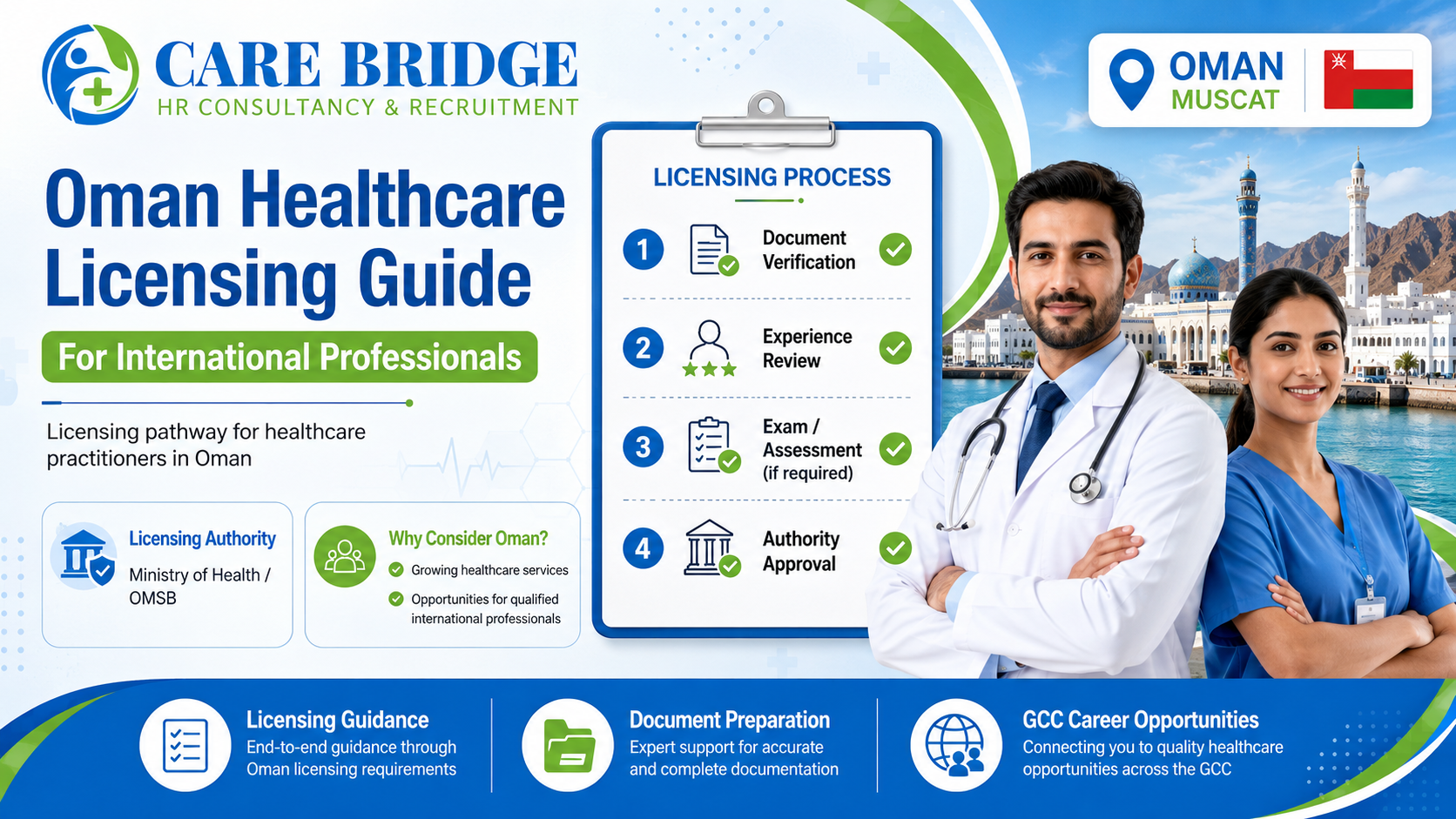
However, healthcare professionals cannot practise in Oman without the correct licensing and authority approval. The licensing process usually involves document preparation, primary source verification, professional experience review, examination or assessment where required, and final approval through the relevant Omani healthcare authority.
For international candidates, this process can feel confusing because Oman licensing may involve the Ministry of Health, private health establishment procedures, and Oman Medical Specialty Board-related examinations or verification pathways, depending on the role and route. A successful application starts with accurate documents, clear experience records, and a realistic understanding of the steps.
Care Bridge Human Resource Consultancies supports healthcare professionals with GCC licensing guidance, recruitment preparation, document review, and employer coordination. This guide explains Oman healthcare licensing for international professionals and helps candidates compare Oman with other GCC opportunities.
Why Oman Appeals to Healthcare Professionals
Oman offers a different healthcare career experience from some larger GCC markets. The country has a growing healthcare sector, a stable professional environment, and a reputation for a more balanced lifestyle. Muscat and other regions continue to develop healthcare facilities, specialist services, and private healthcare investment.
Many international professionals consider Oman because it may offer strong patient care exposure, family-friendly living, and competitive compensation packages depending on the role and employer. Oman may also suit professionals who prefer a calmer environment compared with larger, faster-paced cities in the Gulf.
However, candidates should not choose Oman based only on salary or lifestyle expectations. Licensing readiness, employer type, professional title, experience level, and document accuracy all affect the journey. CareBridge helps candidates assess these factors before starting applications through its healthcare licensing services across the GCC.
Licensing Authority: Ministry of Health and OMSB
Healthcare licensing in Oman can involve the Ministry of Health and Oman Medical Specialty Board-related services, depending on the professional category and process. The Ministry of Health plays a central role in regulating healthcare delivery and professional licensing, especially through structures linked to private health establishments.
The Ministry of Health states that its Directorate General of Private Health Establishments works to simplify procedures for licensing private health establishments and licensing healthcare professionals, while supporting Oman Vision 2040 and digital transformation goals through the Directorate General of Private Health Establishments.
The Oman Medical Specialty Board, known as OMSB, also supports healthcare professional pathways through services such as examinations, verification and equivalency of certificates, CPD accreditation, and occupational classification examinations. OMSB describes its healthcare professional services through its official OMSB healthcare professionals page.
For candidates, the key point is simple: the process may differ by profession, employer, and category. A doctor, nurse, pharmacist, dentist, or allied health professional may not follow the exact same sequence. Before applying, professionals should confirm the correct route for their title and employer type.
Who Needs Oman Healthcare Licensing?
Most healthcare professionals who want to practise clinically in Oman need licensing or authority approval. This includes physicians, dentists, nurses, pharmacists, laboratory staff, radiology professionals, physiotherapists, technicians, and other allied health practitioners.
The required documents and assessment steps depend on the applicant’s role, qualification, experience, and intended scope of practice. A General Practitioner, Specialist, Consultant, Registered Nurse, Pharmacist, or Allied Health Professional may each face different requirements.
Professional title selection matters. A candidate should not apply under a title that does not match their education and clinical experience. If the requested category does not match the evidence, the authority may ask for more documents, classify the applicant differently, or delay the approval.
Candidates comparing Oman with UAE options can review CareBridge’s guide on Specialist vs General Practitioner licensing in the UAE to understand how professional titles affect licensing outcomes across GCC markets.
Key Requirements for Oman Healthcare Licensing
Oman healthcare licensing usually requires a clear set of professional documents. The exact list may vary, but international professionals should prepare the following core items.
1. Recognised Qualification
Applicants need a healthcare degree, diploma, or professional qualification that matches the applied role. The qualification should come from a recognised institution and align with the requested professional category.
For doctors and specialists, postgraduate qualifications, internship records, residency training, board certificates, or fellowship documents may also matter. Nurses and allied health professionals should prepare diploma or degree certificates, transcripts where required, and professional registration documents.
2. Clinical Experience
Authorities and employers review whether the candidate has relevant clinical experience. Experience letters should show job title, facility name, department, employment dates, working status, and key responsibilities.
Experience should also match the CV. Inconsistent dates, unclear designations, or missing signatures can create delays. CareBridge recommends preparing experience records before job applications begin, not after an employer requests them.
3. Professional License or Registration
Most candidates need proof of current or previous professional registration from their home country or previous country of practice. This document helps show that the professional has worked under a recognised regulatory system.
Where applicable, candidates should also prepare a Good Standing Certificate or equivalent professional conduct document. Some authorities or employers may request it during review.
4. Primary Source Verification
Primary Source Verification confirms that qualifications, experience certificates, and professional licenses are genuine. OMSB explains that Primary Source Verification verifies documents directly from the original or primary source, and it is mandatory for Omanis and non-Omanis who obtained qualifications outside the Sultanate through the OMSB Primary Source Verification service.
This step is critical. Verification delays often happen when documents contain spelling differences, unclear stamps, outdated contacts, or incomplete employer details.
5. Examination or Assessment, If Required
Some categories may require an occupational classification examination or professional assessment. Pearson VUE lists Oman Medical Specialty Board occupational classification testing and states that OMSB supports the growth of healthcare human resources by developing specialised physicians and assuring the competencies of healthcare professionals through OMSB testing with Pearson VUE.
Candidates should confirm whether their category requires an exam before booking or preparing. Exam requirements can vary by profession, classification, and authority route.
Oman Healthcare Licensing Process: Step by Step
The process may differ by profession and employer, but most international candidates should expect the following stages.
Step 1: Confirm the Correct Licensing Route
First, identify the correct professional category and likely licensing pathway. This depends on your profession, qualification, experience, and employer type.
A candidate applying to a private clinic may follow a slightly different route from someone joining a government or semi-government facility. Clarify the authority pathway before paying fees or starting verification.
Step 2: Prepare Your Documents
Prepare a clean document set before submission. This should include passport, CV, academic certificates, transcripts where required, internship or training documents, professional license, experience letters, Good Standing Certificate, and previous verification reports if available.
Candidates can use CareBridge’s UAE and GCC licensing document checklist to organise key records and identify gaps early.
Step 3: Complete Primary Source Verification
Submit the required documents for verification. This step may take time because issuing institutions must respond. Candidates should ensure that university, employer, and licensing authority contact details are correct.
Do not submit unclear or inconsistent documents. A small error can delay verification and affect the full application timeline.
Step 4: Complete Exam or Assessment, If Applicable
If your profession or category requires an exam, prepare according to the correct scope. Do not assume that exam rules are the same for every healthcare profession. Doctors, nurses, pharmacists, and allied health professionals may face different assessment requirements.
Step 5: Submit Application and Employer Details
After verification and assessment steps, the application may move toward authority approval. Employer details may also be required, especially where the hiring facility supports the licensing process.
This is why licensing and recruitment should move together. A job offer may support the pathway, but the professional still needs valid approval before clinical practice begins.
Step 6: Receive Approval and Complete Onboarding
Once the authority accepts the application, the professional can move toward employment onboarding. This may include visa processing, contract finalisation, medical checks, facility onboarding, and start-date confirmation.
CareBridge explains the link between licensing and employment steps in its guide on visa and healthcare licensing in the UAE, which also helps candidates understand similar sequencing across GCC markets.
Oman vs UAE and Saudi Arabia: How to Compare Options
Healthcare professionals often compare Oman with the UAE, Saudi Arabia, and Qatar before choosing a GCC destination. Each market has different advantages.
The UAE may appeal to professionals who want a highly international lifestyle, strong private healthcare opportunities, and multiple authority pathways such as DHA, DOH, MOHAP, and DHCC. CareBridge explains these differences in its article on comparing DHA, DHCC, and MOHAP licensing.
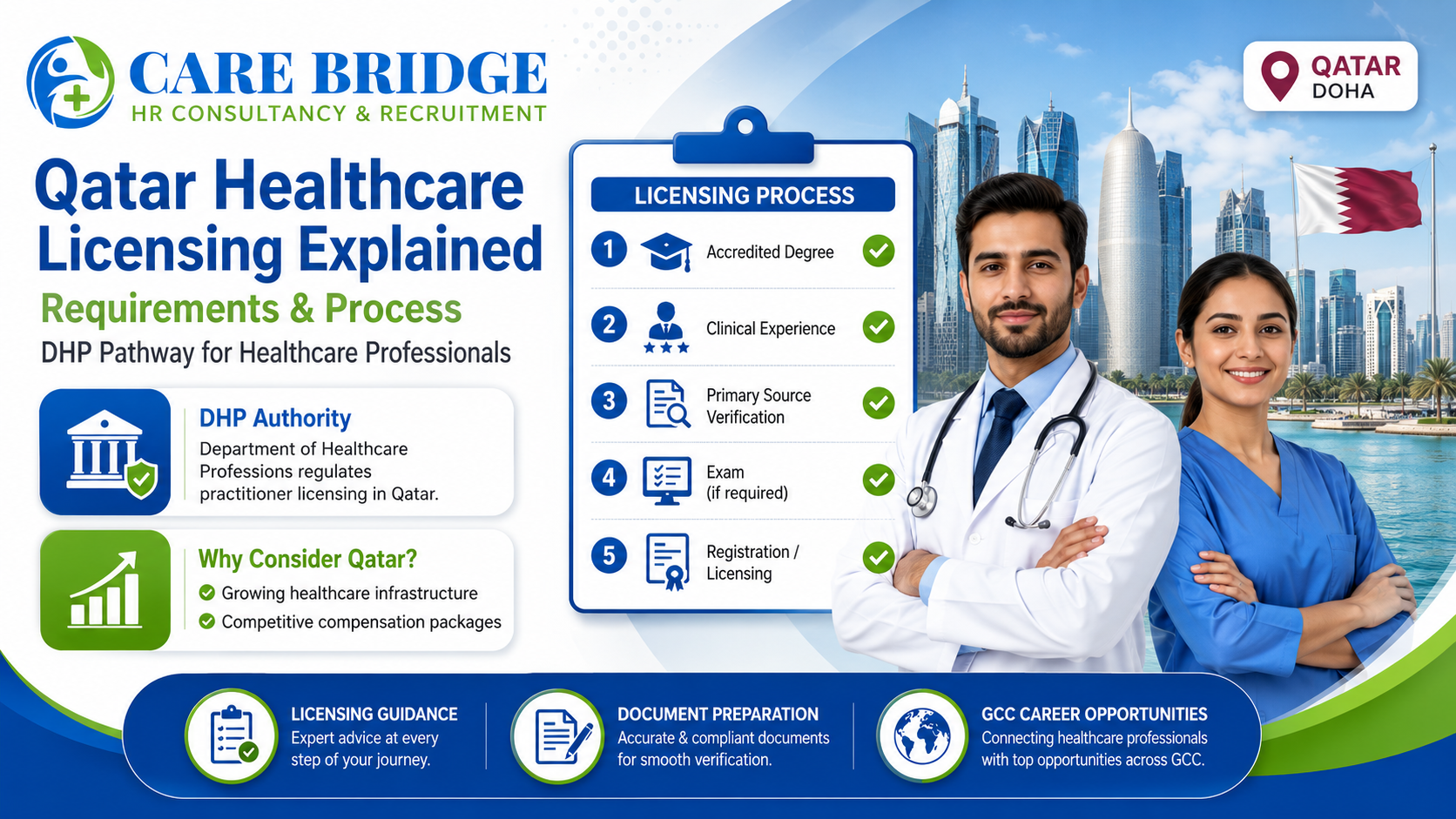
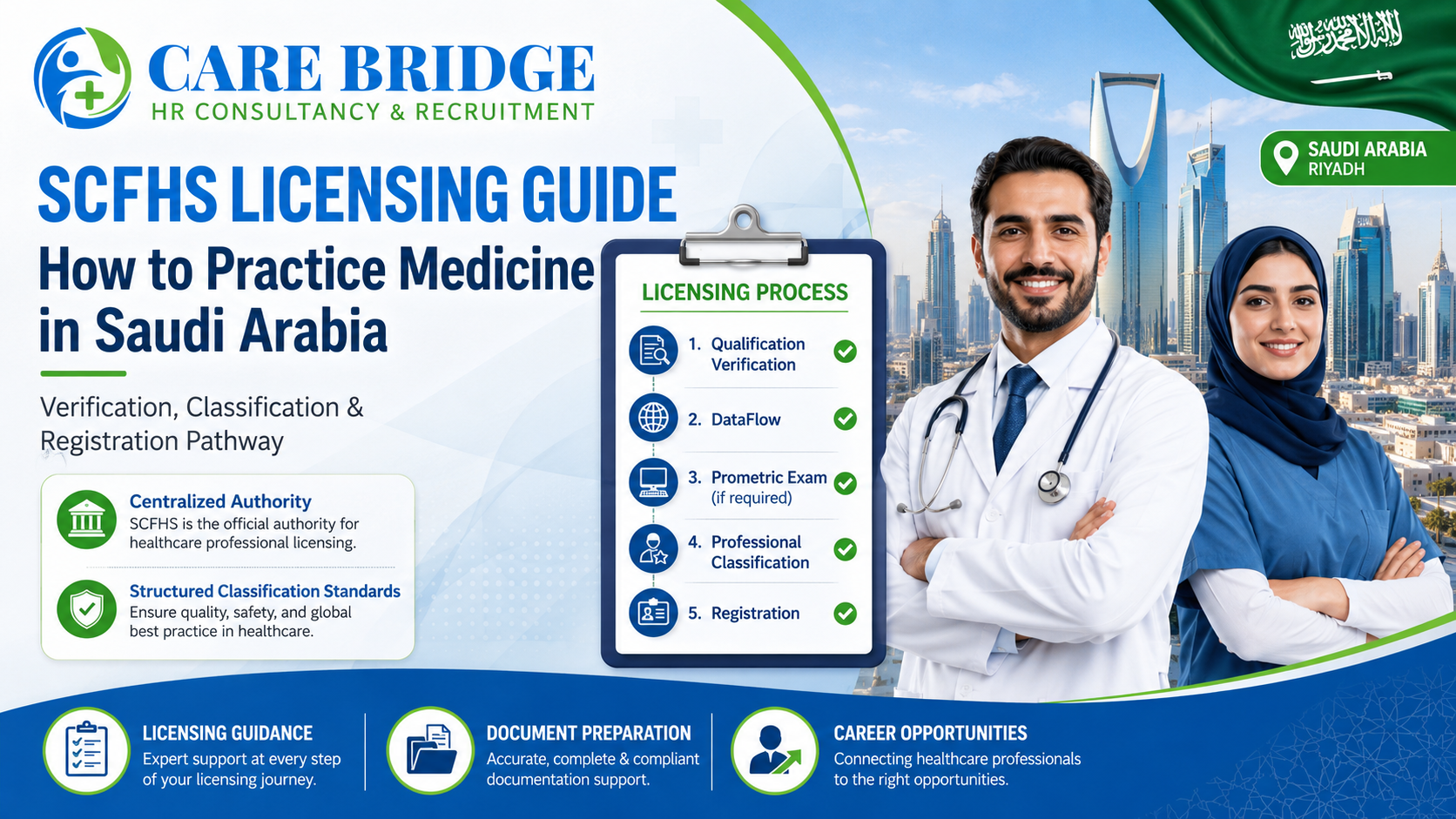
Saudi Arabia may appeal to professionals who want large hospital systems, consultant-level opportunities, and major healthcare transformation projects. Qatar may suit candidates seeking a growing healthcare market with structured DHP licensing.
Oman may appeal to professionals who value stability, a calmer lifestyle, and long-term career development in a developing healthcare market. The best choice depends on licensing eligibility, salary, family needs, employer benefits, and career goals.
Professionals comparing regional compensation can also read CareBridge’s guide on healthcare salary comparison between the UAE and Saudi Arabia as part of broader GCC planning.
Common Mistakes in Oman Healthcare Licensing
Licensing delays often happen because candidates start without reviewing their documents. Common mistakes include missing experience letters, expired licenses, unclear degree certificates, mismatched job titles, incomplete DataFlow or verification records, and applying under the wrong category.
Some candidates also assume that a license from another GCC country automatically allows them to practise in Oman. This is not correct. A UAE, Saudi, Qatar, Bahrain, or Kuwait license may support your professional history, but Oman still needs to assess your qualifications, experience, and approval pathway.
Another common mistake is accepting an offer without understanding the licensing timeline. Employers may interview candidates and issue conditional offers, but the professional still needs to complete verification and authority approval before starting clinical work.
Candidates searching for suitable GCC roles can explore CareBridge healthcare job openings and align job applications with realistic licensing expectations.
How CareBridge Supports Oman and GCC Licensing
Care Bridge Human Resource Consultancies helps healthcare professionals prepare for Oman and wider GCC licensing through a structured process. This reduces confusion and helps candidates understand whether their profile fits the target country and professional title.
CareBridge can support professionals with:
- Oman healthcare licensing pathway guidance
- GCC document readiness checks
- Primary source verification preparation
- Professional category review
- Recruitment and employer coordination
- Interview preparation
- UAE, Saudi Arabia, Qatar, Oman, Kuwait, and Bahrain licensing guidance
This support helps candidates avoid rushed applications, incomplete submissions, and unclear timelines. It also helps employers connect with better-prepared healthcare professionals who understand licensing requirements.
FAQ: Oman Healthcare Licensing for International Professionals
1. Who regulates healthcare licensing in Oman?
Healthcare licensing in Oman may involve the Ministry of Health and Oman Medical Specialty Board-related services, depending on the professional category and pathway. Candidates should confirm the correct route for their role and employer type.
2. Do international healthcare professionals need Primary Source Verification for Oman?
Yes, many international professionals need Primary Source Verification. OMSB states that verification is mandatory for Omanis and non-Omanis who obtained qualifications outside Oman.
3. Is an exam required for Oman healthcare licensing?
Some categories may require an occupational classification examination or professional assessment. The requirement depends on the profession, title, and licensing route.
4. Can I use my UAE or Saudi license to work in Oman?
A UAE or Saudi license may support your professional history, but it does not replace Oman authority approval. You still need to follow the correct Oman licensing process before practising.
5. Is Oman a good option for healthcare professionals?
Oman can be a strong option for professionals seeking GCC experience, stable employment, and a balanced lifestyle. Candidates should compare licensing, salary, employer type, family needs, and career growth before deciding.
6. Can CareBridge help with Oman healthcare licensing?
Yes. CareBridge supports healthcare professionals with Oman and GCC licensing guidance, document review, recruitment preparation, and employer coordination.
Conclusion
Oman healthcare licensing is an important step for international professionals who want to practise in the Sultanate. The process usually involves document preparation, experience review, Primary Source Verification, examination or assessment where required, authority approval, and employer coordination.
Candidates who prepare early reduce delays. Accurate documents, clear experience records, verified credentials, and the right professional category can improve the licensing journey and support smoother onboarding.
Care Bridge Human Resource Consultancies helps healthcare professionals compare Oman, UAE, Saudi Arabia, Qatar, and wider GCC opportunities. With the right licensing support and recruitment guidance, international professionals can move toward a compliant and rewarding healthcare career in Oman.