




SCFHS Licensing Guide: How to Practice Medicine in Saudi Arabia
Saudi Arabia has become one of the most important healthcare destinations in the GCC. The Kingdom continues to expand hospitals, specialist centres, digital health services, and medical training programmes. This growth creates strong opportunities for doctors, nurses, dentists, pharmacists, and allied health professionals who want to build international careers.
However, healthcare professionals cannot practise in Saudi Arabia without the correct professional registration and classification. The Saudi Commission for Health Specialties, known as SCFHS, regulates healthcare practitioners in the Kingdom. It reviews qualifications, verifies credentials, manages professional classification, and supports registration through its official digital systems.
For international professionals, the SCFHS process may feel complex at first. It includes qualification review, DataFlow verification, exam requirements where applicable, classification, registration, and employer-related steps. A strong application starts with clear documents and the right licensing pathway.
Care Bridge Human Resource Consultancies supports healthcare professionals with GCC licensing guidance, recruitment preparation, and employer coordination. This guide explains how SCFHS licensing works, how it differs from UAE licensing, and what professionals should prepare before applying.
What Is SCFHS?
The Saudi Commission for Health Specialties is the main authority responsible for classifying and registering healthcare practitioners in Saudi Arabia. It sets professional standards, reviews qualifications, and helps ensure that healthcare professionals meet the requirements for safe practice.
SCFHS services run through digital systems, including Mumaris Plus. The official SCFHS digital platforms page describes Mumaris Plus as the unified system for services provided to healthcare practitioners. Through this system, applicants can access professional classification, registration, renewal, and related services.
For healthcare professionals considering Saudi Arabia, SCFHS licensing should form part of career planning from the beginning. A job offer may create an opportunity, but the professional still needs the correct classification and registration before practising.
CareBridge provides structured support for professionals exploring Saudi Arabia and other GCC markets through its healthcare licensing services across the GCC.
Who Needs SCFHS Licensing?
Most healthcare professionals who want to practise clinically in Saudi Arabia need SCFHS classification and registration. This includes doctors, dentists, nurses, pharmacists, laboratory professionals, radiographers, physiotherapists, technicians, therapists, and many allied health categories.
The exact requirements depend on the professional title, specialty, qualification level, experience, and employer type. A General Practitioner, Specialist, Consultant, Registered Nurse, Pharmacist, or Allied Health Professional may each follow different requirements.
SCFHS reviews professional qualifications and experience to decide whether the applicant fits the requested category. The authority explains that its professional classification and registration requirements define minimum requirements and basic competencies for healthcare practitioners through its SCFHS practitioner requirements section.
This makes role selection very important. Candidates should not apply under a title that does not match their education, clinical experience, or current registration. A mismatch can lead to delays, additional requests, or a different classification outcome.
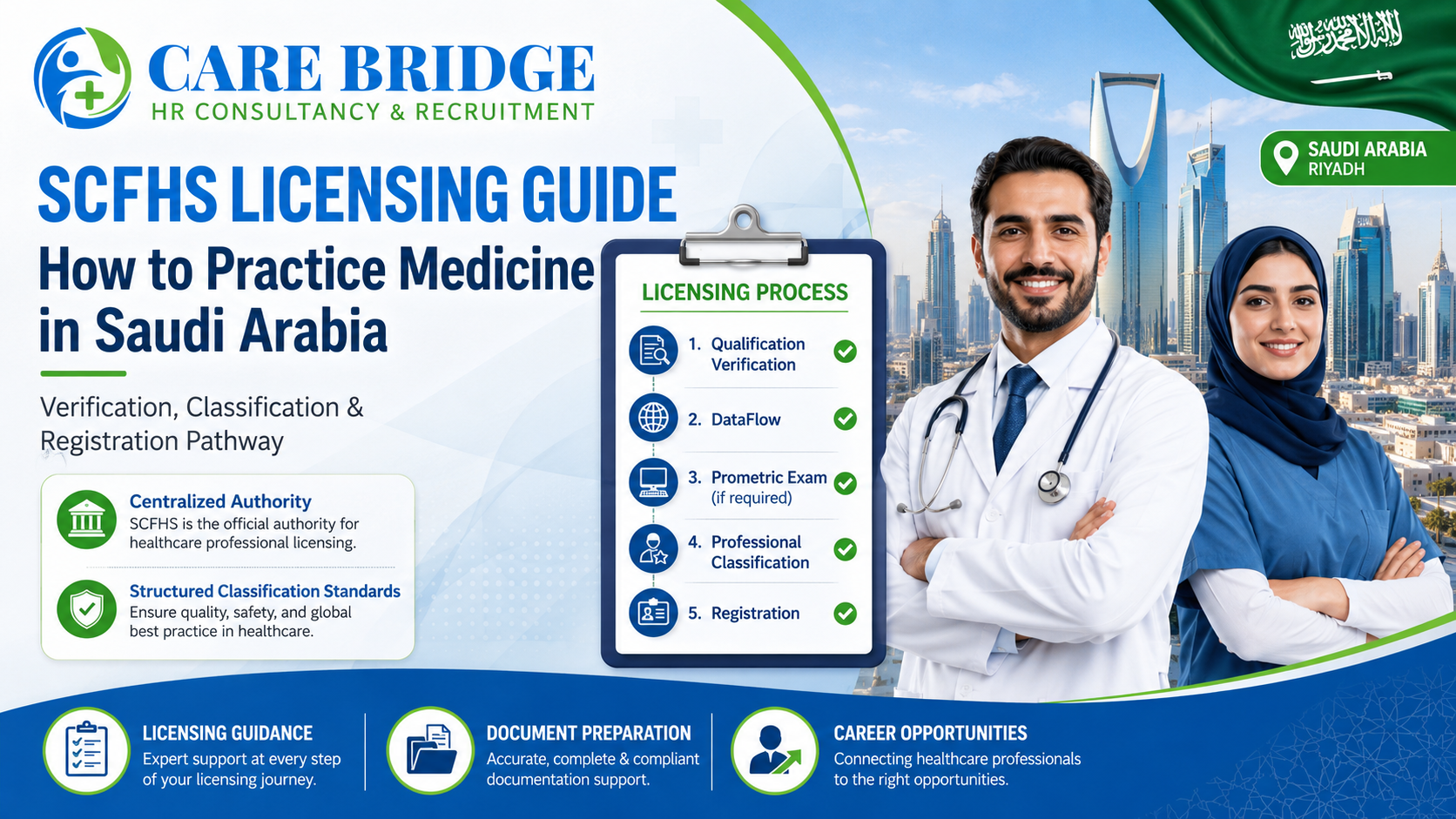
Basic SCFHS Licensing Process
The SCFHS process may vary depending on profession, nationality, previous licensing history, and employer requirements. However, most international healthcare professionals should expect the following key stages.
1. Qualification and Document Review
The first step involves checking whether your education, experience, license, and professional documents meet the relevant SCFHS category. Applicants should prepare clear copies of their degree or diploma, internship or training certificates where applicable, professional license or registration, experience letters, passport, and other supporting records.
Experience letters should match your CV. They should show accurate job titles, employment dates, department, clinical duties, and facility details. Inconsistent records can create problems during verification and classification.
Before starting a Saudi pathway, healthcare professionals can also review their readiness using CareBridge’s UAE and GCC licensing document checklist, which helps candidates organise documents before authority submission.
2. DataFlow Primary Source Verification
SCFHS applications often require Primary Source Verification. DataFlow checks credentials directly with the original issuing institutions, such as universities, employers, and licensing councils. This protects employers, regulators, and patients by confirming that submitted credentials are genuine.
The DataFlow Group states that it collaborates with SCFHS to authenticate credentials for healthcare professionals seeking to practise in Saudi Arabia through the SCFHS DataFlow verification pathway.
Applicants should make sure their documents are accurate before verification starts. A spelling difference, unclear stamp, incorrect date, or unreachable issuing authority can slow the process. If DataFlow returns a negative or unable-to-verify result, the applicant may need to provide extra evidence or correct the issue.
3. Prometric Exam, If Required
Some professionals must pass an SCFHS-related exam before classification or registration. Exam requirements depend on profession, specialty, qualification, and exemption rules. Doctors, nurses, pharmacists, and allied health professionals should confirm whether their category requires a written exam.
SCFHS lists Prometric as an official e-service for exam-related access through the SCFHS Prometric service. Candidates should prepare early and avoid booking exams without confirming the correct category.
Exam preparation should match the intended classification. A nurse applying for one category may face a different test structure from a pharmacist or physician. Candidates should also check identification rules, booking requirements, and validity timelines before scheduling.
4. Professional Classification
Professional classification is one of the most important steps. SCFHS reviews the applicant’s education, training, experience, license history, and exam status to decide the appropriate professional level.
For doctors, classification may involve categories such as General Practitioner, Specialist, Senior Registrar, or Consultant, depending on qualifications and experience. Nurses, pharmacists, dentists, and allied health professionals also have category-specific pathways.
A candidate may hope for a higher category, but SCFHS will classify the profile based on evidence. This is why document quality and category selection matter. Professionals should avoid overclaiming experience or applying for a title that their records cannot support.
5. Professional Registration Through Mumaris Plus
After classification requirements are met, applicants move through professional registration. SCFHS explains that professional registration includes logging into Mumaris Plus, selecting the service, completing application data, uploading documents, reviewing information, paying fees, and submitting the application through the official SCFHS professional registration service.
This step confirms the professional’s registration status and supports legal practice under the relevant rules. Employers may also have facility-side requirements before the professional begins work.
Professionals should keep copies of submission receipts, classification outcomes, DataFlow reports, and registration confirmations. These documents may help with employer onboarding and future renewals.
How SCFHS Licensing Differs from UAE Licensing
Saudi Arabia and the UAE both regulate healthcare professionals carefully, but the systems work differently.
Saudi Arabia has a more centralised model through SCFHS. Healthcare professionals generally deal with one national authority for professional classification and registration. This can make the Saudi pathway clearer in terms of national regulation, but classification standards may feel strict because the authority reviews the professional category in detail.
The UAE uses different authorities depending on location. Dubai professionals often follow DHA. Abu Dhabi professionals follow DOH. Northern Emirates roles may fall under MOHAP. Dubai Healthcare City may require DHCC. CareBridge explains these differences in its guide on comparing DHA, DHCC, and MOHAP licensing.
This difference affects career planning. A healthcare professional comparing Riyadh and Dubai must compare both salary and licensing route. Saudi Arabia may require SCFHS classification. Dubai may require DHA eligibility and facility activation. Abu Dhabi may require DOH approval. Each pathway has its own timeline and document requirements.
Professionals who want to understand UAE authority differences can also review CareBridge’s guide on Specialist vs General Practitioner licensing in the UAE before comparing titles across GCC markets.
Common Challenges in SCFHS Applications
SCFHS applications can face delays when documents do not match authority expectations. Most problems happen before submission or during verification.
Common challenges include:
- Incomplete experience letters
- Expired professional registration
- Missing good standing certificates
- Degree or diploma inconsistencies
- Job titles that do not match the requested classification
- DataFlow delays from issuing institutions
- Exam category confusion
- Gaps in clinical practice
- Applying under the wrong professional title
Candidates should also understand that an employer interview and SCFHS approval are separate matters. A hospital may want to hire you, but the licensing pathway still needs to work. This is similar to UAE recruitment, where licensing and employment must align. CareBridge explains this connection in its guide on visa and healthcare licensing in the UAE.
Saudi Arabia vs UAE: How to Compare GCC Opportunities
Many healthcare professionals compare Saudi Arabia and the UAE before accepting an offer. Both markets offer strong opportunities, but they suit different career goals.
Saudi Arabia may appeal to professionals who want large hospital systems, consultant-level opportunities, major transformation projects, and strong packages in certain specialties. The UAE may appeal to candidates who want a highly international lifestyle, private-sector opportunities, and strong urban healthcare markets in Dubai, Abu Dhabi, and other emirates.
Licensing should guide this decision. A salary offer may look attractive, but the professional must meet the correct authority requirements. SCFHS classification in Saudi Arabia, DHA or DOH approval in the UAE, and facility activation all affect joining timelines.
Professionals comparing salary, licensing, and lifestyle can read CareBridge’s article on healthcare salary comparison between the UAE and Saudi Arabia.
How CareBridge Supports SCFHS and GCC Licensing
Care Bridge Human Resource Consultancies helps healthcare professionals plan licensing before they commit to a role. This support reduces confusion and helps candidates understand whether their profile fits Saudi Arabia, the UAE, or another GCC country.
CareBridge can support professionals with:
- SCFHS licensing pathway guidance
- GCC document readiness checks
- DataFlow preparation support
- Professional category review
- Recruitment and employer coordination
- Interview preparation
- UAE, Saudi Arabia, Qatar, Kuwait, Oman, and Bahrain licensing guidance
This support helps candidates avoid rushed applications, unclear document submissions, and unrealistic joining expectations. It also helps employers connect with better-prepared healthcare professionals.
Candidates searching for regional roles can review CareBridge healthcare job openings and align their licensing preparation with real opportunities.
FAQ: SCFHS Licensing in Saudi Arabia
1. What is SCFHS licensing?
SCFHS licensing refers to the classification and registration process healthcare professionals must complete to practise in Saudi Arabia. The Saudi Commission for Health Specialties reviews qualifications, experience, verification results, and exam requirements before confirming professional status.
2. Do all healthcare professionals need DataFlow for Saudi Arabia?
Many applicants need Primary Source Verification through DataFlow, especially international candidates. The requirement depends on the profession, documents, and authority process. Candidates should prepare verified education, license, and experience records before submission.
3. Is the Prometric exam required for SCFHS?
Not for every applicant. Exam requirements depend on profession, category, and eligibility rules. Some healthcare professionals must pass a Prometric exam before classification or registration. Others may qualify through different assessment routes or exemptions.
4. Is SCFHS harder than UAE licensing?
It depends on the candidate’s profession and documents. Saudi Arabia uses a centralised SCFHS system, while the UAE uses different authorities such as DHA, DOH, MOHAP, and DHCC. SCFHS classification may feel stricter when the requested title does not clearly match the candidate’s qualifications or experience.
5. Can I use a UAE license to work in Saudi Arabia?
A UAE license may support your professional history, but it does not replace SCFHS classification and registration. You still need to follow the Saudi licensing pathway before practising in Saudi Arabia.
6. Can CareBridge help with SCFHS and GCC licensing?
Yes. CareBridge supports healthcare professionals with GCC licensing guidance, document review, recruitment preparation, and employer coordination. This helps candidates compare Saudi Arabia, the UAE, and other regional opportunities with better clarity.
Conclusion
SCFHS licensing is a key requirement for healthcare professionals who want to practise medicine or work clinically in Saudi Arabia. The process usually involves document review, DataFlow verification, Prometric exams when required, professional classification, and registration through Mumaris Plus.
Saudi Arabia offers strong healthcare career opportunities, but candidates need to plan carefully. The right professional title, complete documents, verified credentials, and clear employer coordination can reduce delays and improve the chance of a smooth transition.
Care Bridge Human Resource Consultancies helps healthcare professionals compare GCC opportunities, prepare licensing documents, and understand the steps required for Saudi Arabia and the UAE. With the right preparation, healthcare professionals can move toward a compliant and rewarding career in the Saudi healthcare sector.